Spray Booths Guide
How to Choose an Industrial Spray Booth
A spray booth decides what work you can accept, how fast you turn it around, and what it costs to run every hour it is on.
This guide puts the decisions in the order that works, because each one constrains the next. Work through it and you end up with a specification rather than a shopping list, which is also what makes quotes comparable.
Quick Answer
Start with the work: the largest part you will finish, the coatings you spray, and your throughput. Those three answers set the booth type, the airflow pattern and the size. Next confirm what your building can actually supply, since available power and gas often decide the heating question on their own. Compliance, installation scope and the manufacturer's engineering capability come last.
1. Start with the work, not the booth
Three answers set almost everything downstream. Write them down before you speak to a supplier.
The part. The largest one you will realistically finish, with length, width, height and weight. Also the typical part, how it is supported or moved, and whether sizes are trending up. Industrial spray booth sizes turns this into dimensions.
The coating. What you spray now and expect to spray later, whether solvent-borne, waterborne, high solids or powder; the application temperature and cure schedule the coating manufacturer specifies; and the finish standard the work has to meet. A Class A automotive finish and a functional industrial coating are different specifications, and paying for the first when you need the second is a common and expensive mistake. Powder leads to powder coating booths and cure ovens rather than a liquid booth; liquid leads to liquid coating.
The throughput. Parts per shift, cycle time per stage, and where the bottleneck sits today. If spray, flash and cure all happen in one enclosure, that enclosure is tied up for the whole cycle. A booth plus a prep station and a mixing room often costs less than one larger booth and moves more work through.
2. Choose the booth type and airflow pattern
Booth type follows the finish standard and the part.
| Booth type | Typical fit |
|---|---|
| Open face | Smaller parts, general industrial work, lower installed cost |
| Enclosed cross draft | General industrial finishing where full enclosure is needed |
| Semi downdraft | A quality step up without full pit work |
| Downdraft | Highest finish quality, automotive and precision work, needs a pit or raised floor |
| Drive-through | Vehicles and long parts needing entry and exit at both ends |
| Bench | Small components and bench work |
| Blast and sanding | Surface preparation rather than coating |
Airflow pattern is the decision inside that one, and it drives finish quality, footprint and installed cost together. Spray booth ventilation requirements explains how each pattern behaves.
3. Size it around the part
Size is the part plus working clearance plus access, not the part plus a round number. Check three things:
- Interior. Operator access to every sprayed surface, part movement inside the booth, airflow reaching all surfaces, lighting angles
- Door openings. The part plus whatever carries it, including forklift mast height and crane clearance
- The building. Usable floor area, clear height under services, column positions, floor loading, and the route from the door to the booth
Undersizing limits the shop permanently. Oversizing costs money every hour the booth runs. Industrial spray booth sizes works through the trade.
4. Decide heating, then placement
Heating is two separate questions: do you need stable application temperature, and do you need a bake or cure cycle.
Fuel is usually decided by the building. Gas costs less to run at industrial air volumes but needs supply, venting and combustion air. Electric installs more simply but needs substantial electrical capacity and costs more per hour. Heating also follows airflow, because the air makeup unit is sized against the booth's exhaust volume, so booth size, airflow and heating are one connected decision. See spray booth heating systems.
On placement: if the building has usable space with adequate clear height and a workable exhaust route, indoor is straightforward. If it does not, an outdoor spray booth is often better than compressing the booth to fit or expanding the building. It frees interior floor space and avoids construction, at the cost of a foundation, weather-rated construction and exterior utility runs. Indoor versus outdoor spray booths sets out the comparison, including the permitting differences.
5. Check what the building can supply
Confirm these in writing before specifying equipment. A service upgrade discovered late can rival the cost of the booth.
- Available electrical service and genuine spare capacity, not nameplate capacity
- Whether gas is available, at what capacity and pressure
- Compressed air capacity for spray equipment
- Where exhaust can reach the outside, and where discharge can legally terminate
- Structural capacity for anything mounted overhead or on the roof
- Whether the building can supply makeup air, or the booth must
Controls and lighting belong in the same conversation, because both are far easier to include at design than to retrofit. Controls cover motor control and whether variable frequency drives are justified, airflow and pressure monitoring, filter differential monitoring, cycle control, interlocks preventing spray without ventilation, and temperature control where the booth is heated. See control panels. Lighting is set by booth size, geometry and area classification rather than preference, and under-lit booths produce rework nobody attributes to lighting. See LED booth lighting.
6. Compliance, installation, and the manufacturer
Compliance belongs in design, not after fabrication. Establish four things before anything is built:
- Your authority having jurisdiction, and which code editions and amendments they enforce
- Whether air quality permitting applies to your coatings and volumes
- What your insurer requires
- What documentation plan review expects
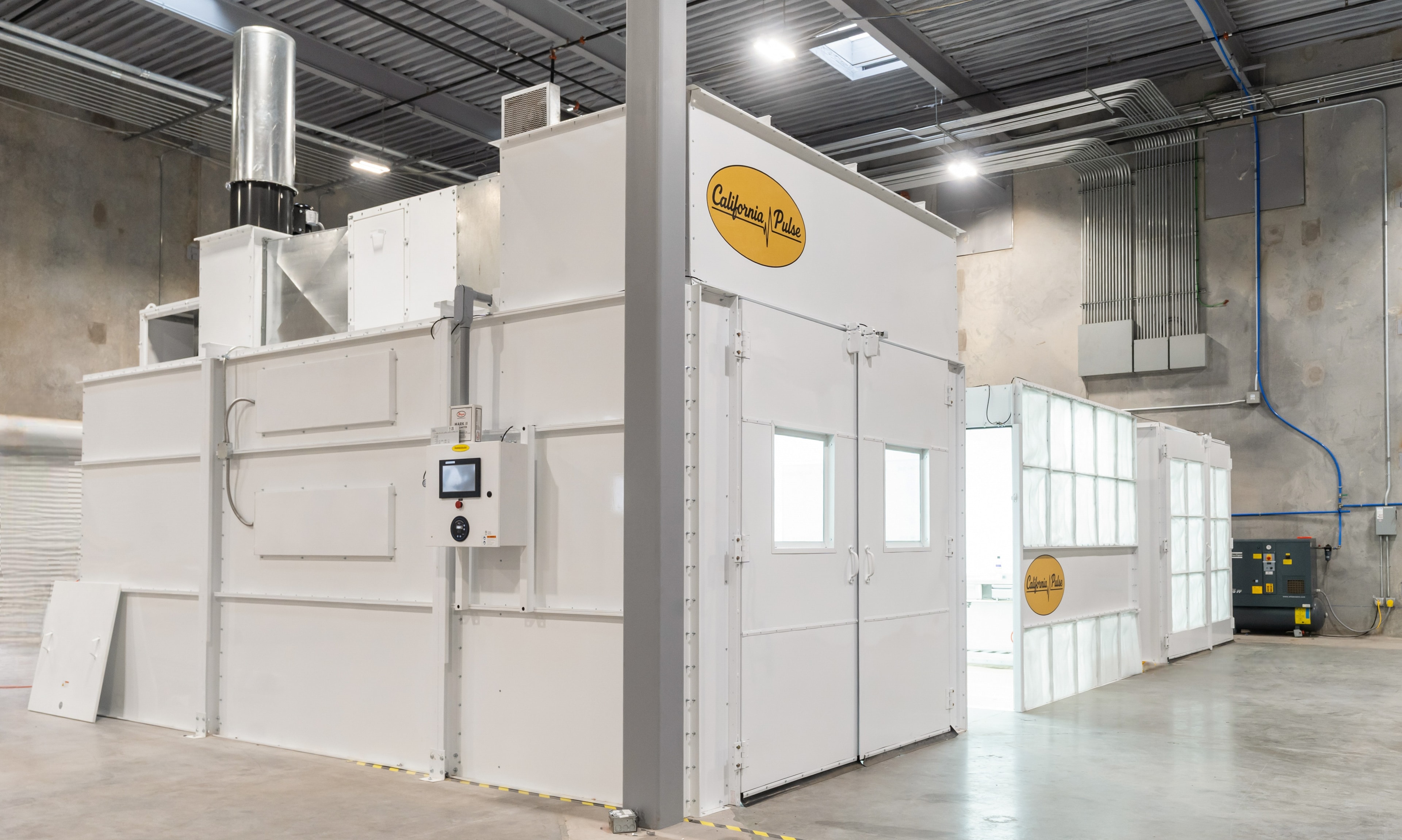
NFPA 33, NFPA 86 where curing is involved, and OSHA's spray finishing requirements are the usual standards. California Pulse systems are ETL Listed by Intertek and built to NFPA 33 and NFPA 86, and we supply drawings, airflow calculations and electrical documentation for submittal; the approval stays with your authority. See requirements, codes and compliance and AHJ and permitting.
Settle scope before comparing quotes. Two numbers covering different scopes are not comparable. Agree who handles foundations and site work, mechanical and electrical installation, ducting and discharge, commissioning, and operator training, then look past handover to filter cost, service access and parts support. See installation and commissioning, project management, service and preventive maintenance and the maintenance guide.
Custom or standard usually answers itself by now. If a standard configuration fits the part, the building and the process, take it. Industrial work often falls outside standard envelopes, and a booth engineered to the part then avoids both a booth that is too small and the running cost of one that is too large. See custom spray booth design.
Ask any manufacturer these five questions. Compare installed scope and running cost, not headline price.
- Do they engineer to your application, or fit you to a catalogue?
- Do they ask about parts, building, power and jurisdiction before quoting?
- Is the equipment listed by a recognised laboratory, and to which standards?
- Will they supply drawings, calculations and electrical documentation for permitting?
- Is the quote explicit about scope, and do they support installation and service?
Why companies choose California Pulse sets out how we work.
The checklist
Take this to any supplier conversation:
- Largest part dimensions and weight, and how it is handled
- Coatings, and whether a bake or cure cycle is required
- Throughput target and current bottleneck
- Required finish standard
- Booth type and airflow pattern
- Interior dimensions and door openings
- Heating requirement and fuel
- Indoor or outdoor placement
- Available electrical service, gas, and compressed air
- Controls and lighting scope
- Authority having jurisdiction and known local requirements
- Scope split for installation and site work
- Maintenance plan and filter supply
If you can answer these, you can get comparable quotes and a system that fits. If not yet, the other guides in the Learning Center fill the gaps.
From California Pulse
Related equipment & services

Answers
Frequently asked questions
Still have a question about your project? Send it with your details and our engineers will answer it in writing.
How do I choose the right industrial spray booth?
What is the most important factor when buying a spray booth?
Should I buy a standard or custom spray booth?
What should I ask a spray booth manufacturer?
How long does it take to get an industrial spray booth?
What information do you need to quote a spray booth?
Keep Reading
Related resources
Industrial Spray Booth Cost
The variables that move spray booth pricing, why a single published price is misleading, and how to build a realistic project budget.
Read GuideIndustrial Spray Booth Sizes
Sizing starts with the part, not a catalogue number. Clearances, door openings, handling, facility limits, and future capacity.
Read GuideIndustrial Spray Booth Requirements
Ventilation, electrical, lighting, fire protection, filtration, exhaust, clearances, and permitting, and why requirements vary by project.
Read GuideSpray Booth Heating Systems
Application heat, cure cycles, gas versus electric, air makeup units, and how to work out which system your process needs.
Read GuideIndoor vs Outdoor Spray Booths
Space, weather, structure, installation, maintenance, permitting, and cost compared for both placements.
Read GuideSpray Booth Ventilation Requirements
Intake and exhaust, airflow patterns, pressure balance, filtration, air makeup, and the ventilation mistakes worth avoiding.
Read Guide
Back to the Spray Booth & Finishing Systems Learning Center.
Free Resource
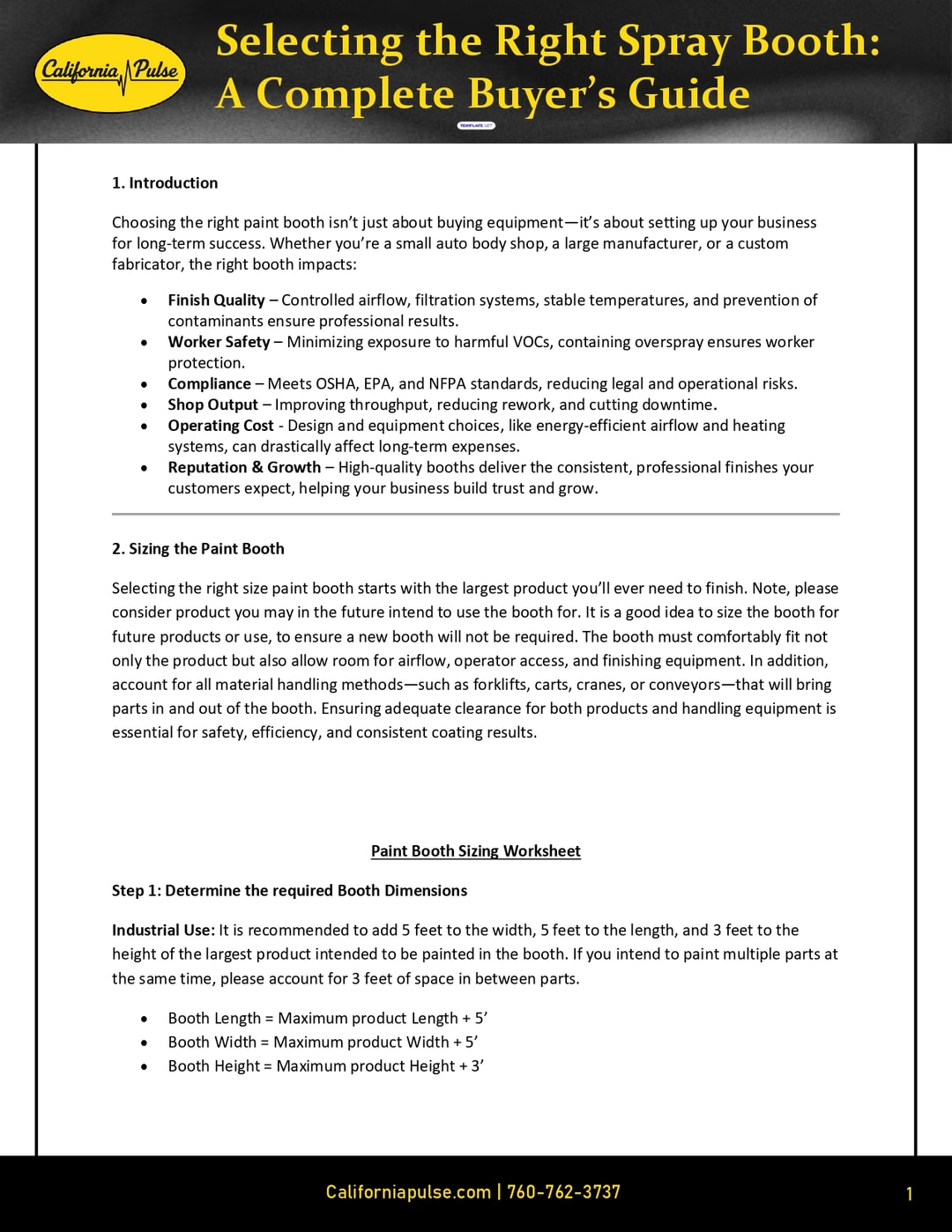
Get the Free Buyer’s Guide
Everything you need to size, spec, and buy the right system: finish quality, worker safety, code compliance, operating cost, and a step-by-step sizing worksheet.
Talk through your spray booth project
If you are planning a booth, send us your parts, your building, and what you need it to do. Our engineers will specify a system and quote it in writing, with no obligation.