California Pulse
Liquid Coating
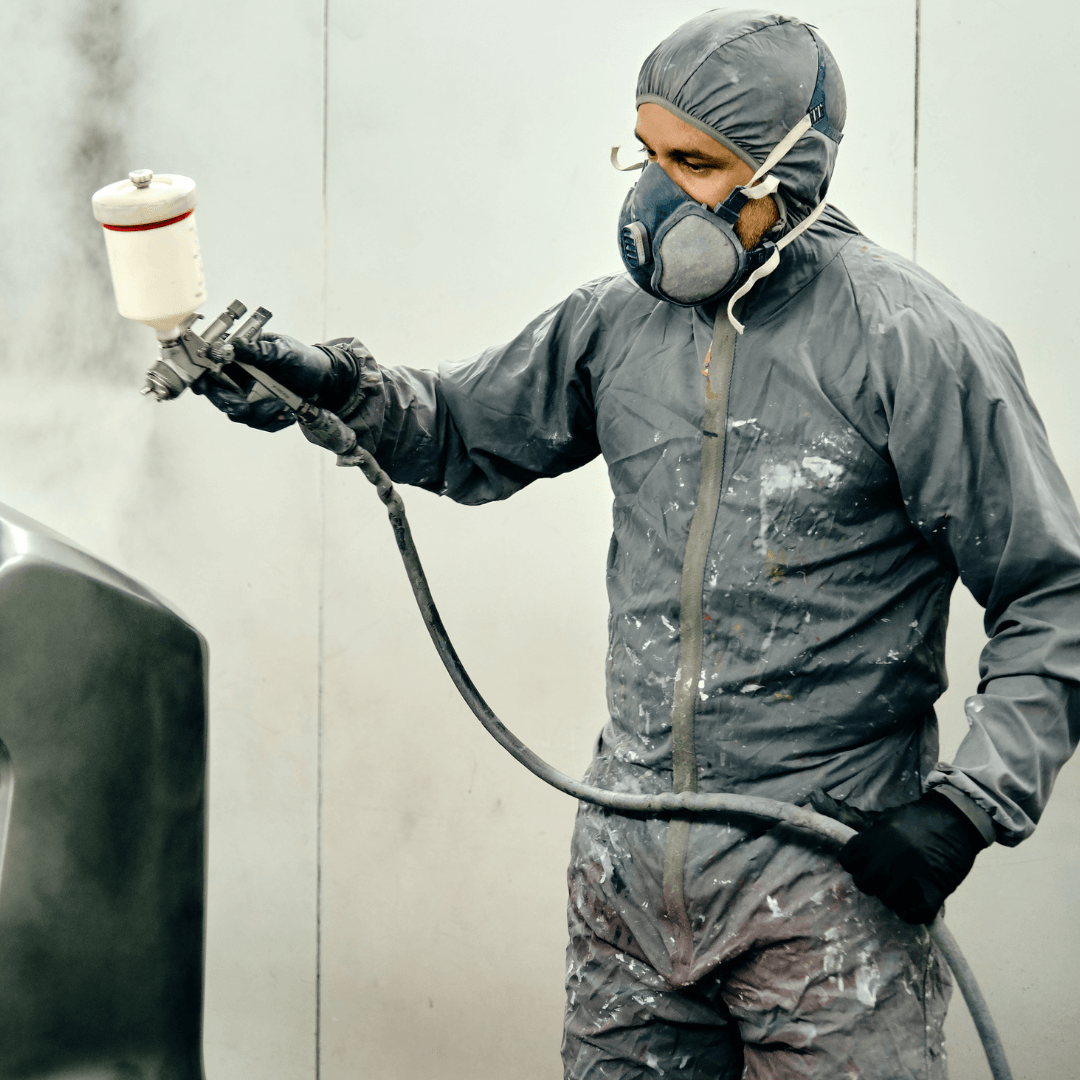
Liquid coating is the most versatile of the industrial finishing processes and the most demanding to enclose safely. A wet coating is atomized and sprayed onto the part, the solvent carrier evaporates during flash-off, and the film cures either by air drying or by chemical cross-linking, often accelerated with a low-temperature bake.
Because it needs no electrical conductivity and no high-temperature cure, liquid coating handles substrates and assemblies that powder cannot touch: heat-sensitive assemblies, plastics, wood, fiberglass and composite parts, and structures far too large for any oven. The trade-off is that the solvents being atomized are flammable, and that fact drives the entire equipment design. Airflow velocity, electrical classification, filtration, and interlocks all exist to manage it.
Liquid coating chemistries
The coating manufacturer specifies the system, but the chemistry determines what the booth has to provide in airflow, temperature, and cure time.
- Two-component (2K) polyurethanes. The industrial workhorse for topcoats. Excellent gloss retention, UV stability, and chemical resistance; requires accurate mixing and has a defined pot life.
- Epoxy primers and coatings. Outstanding adhesion and corrosion protection, which is why they dominate primer coats and tank and structural work. Chalk under UV, so they are usually topcoated outdoors.
- Alkyd enamels. Lower cost, simple single-component application, longer cure. Common on equipment and structural steel where appearance requirements are moderate.
- High-solids and compliant coatings. Reformulated to carry more solids and less solvent to meet VOC limits. They build film faster but are more viscous and more sensitive to application technique and temperature.
Booth airflow designs
Airflow is the core of a liquid spray booth. It carries overspray away from the operator's breathing zone and away from the wet finish, and it keeps solvent vapour concentration well below the lower explosive limit. Four patterns cover most industrial work, and they are not equivalent in either finish quality or cost.
Crossdraft
Air enters at the front and exhausts through a filter bank at the rear, moving horizontally past the part. It is the simplest and least expensive design, needs no pit and no elevated floor, and suits primer work, structural steel, and general industrial finishing. The limitation is that air travelling the length of the booth picks up overspray as it goes, so finish quality at the downstream end is not what it is at the front.
Semi-downdraft
Air enters through a filtered ceiling plenum at the front of the booth and exhausts at floor level at the rear, moving diagonally across the part. It is a meaningful improvement over crossdraft for finish quality while still avoiding the excavation a full downdraft needs. It is usually the best value when appearance matters but a pit is not practical.
Side downdraft
Air enters through the full ceiling and exhausts through filtered pits or plenums along both side walls at floor level. It delivers most of the finish quality of a full downdraft without excavating a full-length under-floor pit, and it is a common choice for large equipment and truck work where a raised floor would be impractical.
Full downdraft
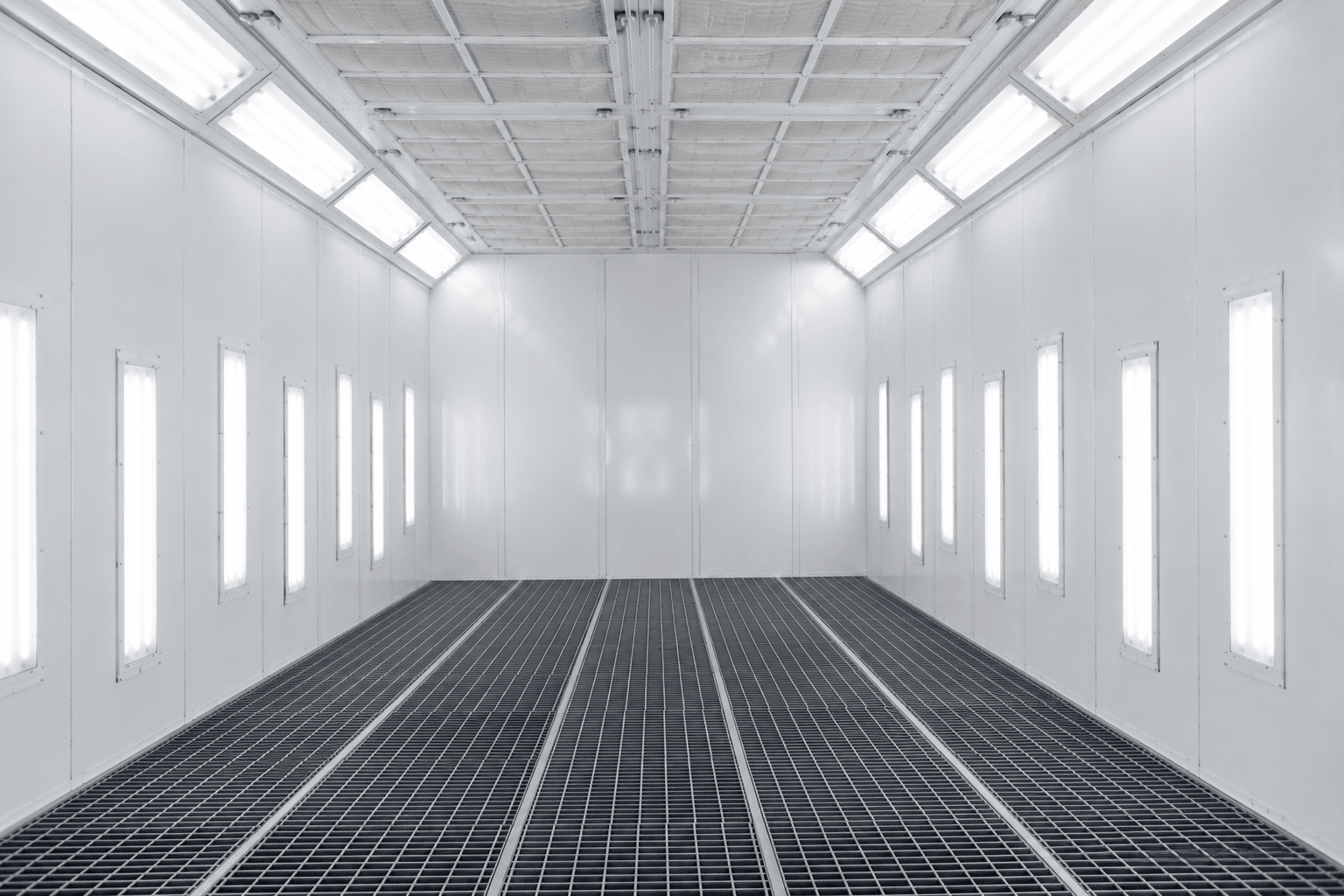
Air enters through the entire filtered ceiling and exhausts vertically through a grated floor into a basement pit or a raised sub-floor. Air moves past the part once, in one direction, carrying overspray straight down and away. It gives the cleanest finish available and is the standard for automotive and high-appearance work. It is also the most expensive to build, because it requires either excavation or a raised floor with ramps.
Flash-off, force dry, and bake
Applying the coating is only part of the cycle. Solvent has to leave the film in a controlled way, and rushing it traps solvent under a skinned surface, producing solvent pop, blistering, and soft films that never reach full hardness.
Flash-off is the ambient-temperature dwell between coats that lets the bulk of the solvent evaporate. Force dry raises booth temperature moderately, commonly in the 140°F to 180°F range for industrial coatings, to accelerate cure and free the booth for the next part. A dedicated bake cycle with a controlled ramp, dwell, and cool-down is used where the coating specification calls for it. Each of these needs make-up air heat, and heated make-up air is normally the largest single energy cost of running a liquid booth.
Filtration and emissions capture
A liquid booth filters twice, for two different reasons. Intake filtration cleans the air reaching the part, because any particle in that airstream is a defect in the finish. Exhaust filtration captures paint overspray before the air leaves the building, which is what your air district permit is written against.
Exhaust filter selection is a real efficiency-versus-static-pressure trade-off, and the practical failure mode is neglected change intervals: loaded filters raise static pressure, airflow drops below the design velocity, and the booth quietly stops meeting both its finish specification and its code requirement at the same time. Airflow proving and differential pressure monitoring exist so this is visible rather than discovered at an inspection.
Codes, electrical classification, and California VOC rules
Spray application of flammable and combustible materials is evaluated against NFPA 33, together with the OSHA general industry standards and the electrical and mechanical codes adopted locally. Booths with bake or force dry cycles may also fall within the scope of NFPA 86.
The practical consequence is electrical area classification. The spray area and a defined envelope around it are classified hazardous locations, which dictates the lighting fixtures, motors, wiring methods, and any equipment brought inside. It also dictates interlocks: spray equipment is permitted to operate only while the exhaust fan is proving airflow, and the booth purges before heat is applied. These are the details inspectors examine most closely, and they are also where non-listed assemblies most often fail review.
On the emissions side, solvent-borne liquid coating carries the heaviest VOC burden of the finishing processes. California air districts such as SCAQMD, SJVAPCD and BAAQMD set VOC content limits by coating category, along with transfer efficiency requirements that in practice mean HVLP or equivalent application equipment. These limits are a common reason shops move toward waterborne or high-solids systems.
Compare liquid coating against powder coating.
Frequently asked questions
What is liquid coating?
Which booth airflow design should I choose?
Why is a spray booth an electrically classified area?
What is the lower explosive limit and how does the booth control it?
Do I need heated make-up air?
How often do booth filters need changing?
Can a liquid booth also spray waterborne coatings?
What causes solvent pop, orange peel, and dirt in the finish?
What VOC limits apply to liquid coating in California?
How large a part can a liquid coating booth handle?
Equipment
Related equipment
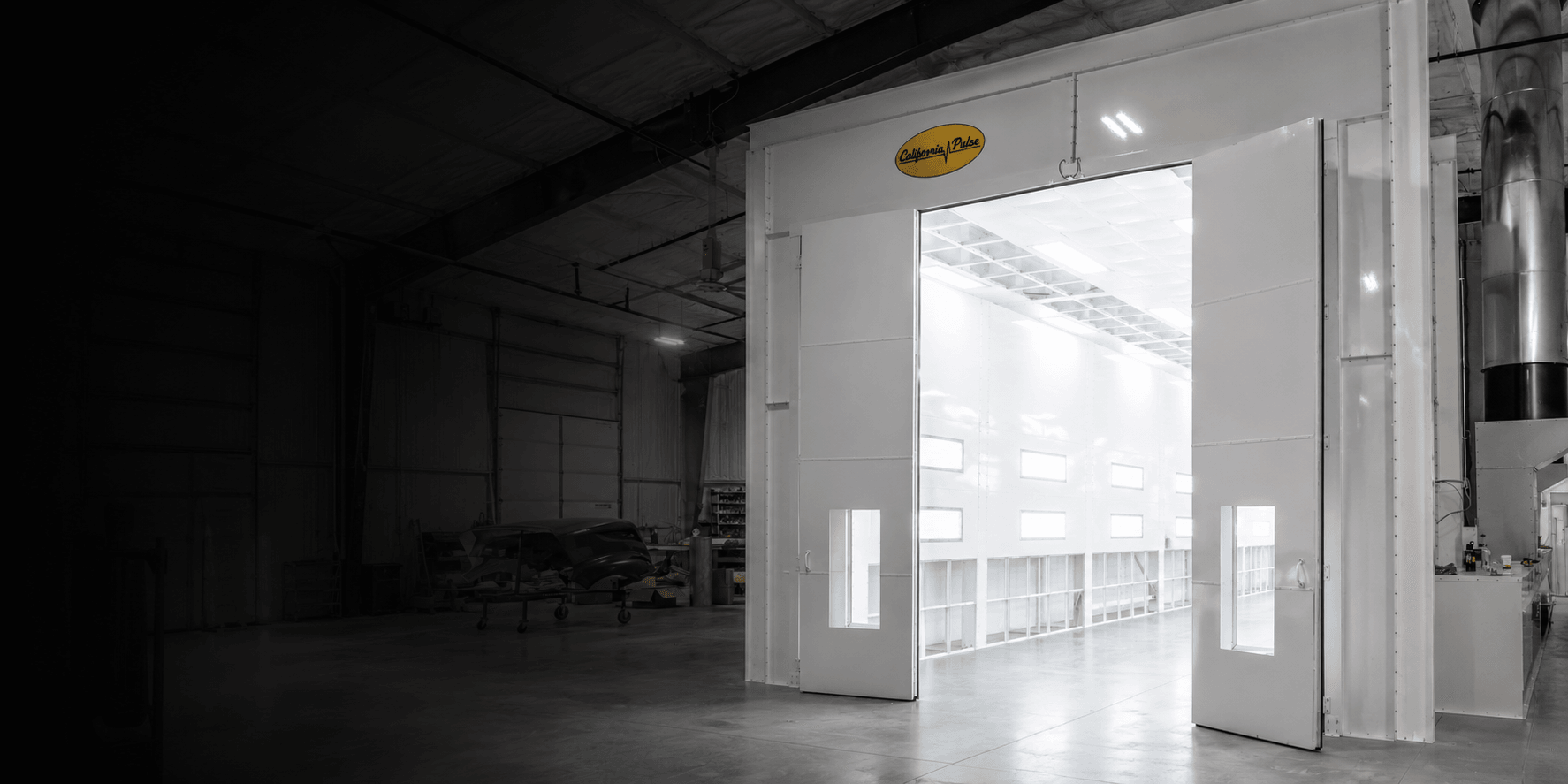 Industrial spray booth rangeThe full catalogue of booth types California Pulse builds, from open face to fully enclosed downdraft.
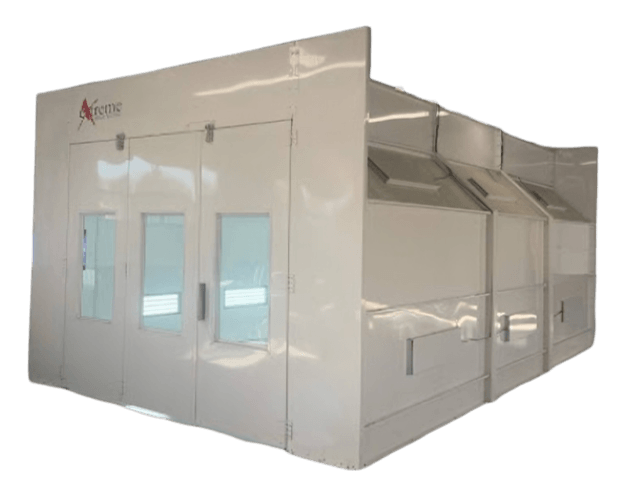 Automotive spray boothsDowndraft and semi-downdraft booths for collision, restoration, and OEM refinishing.
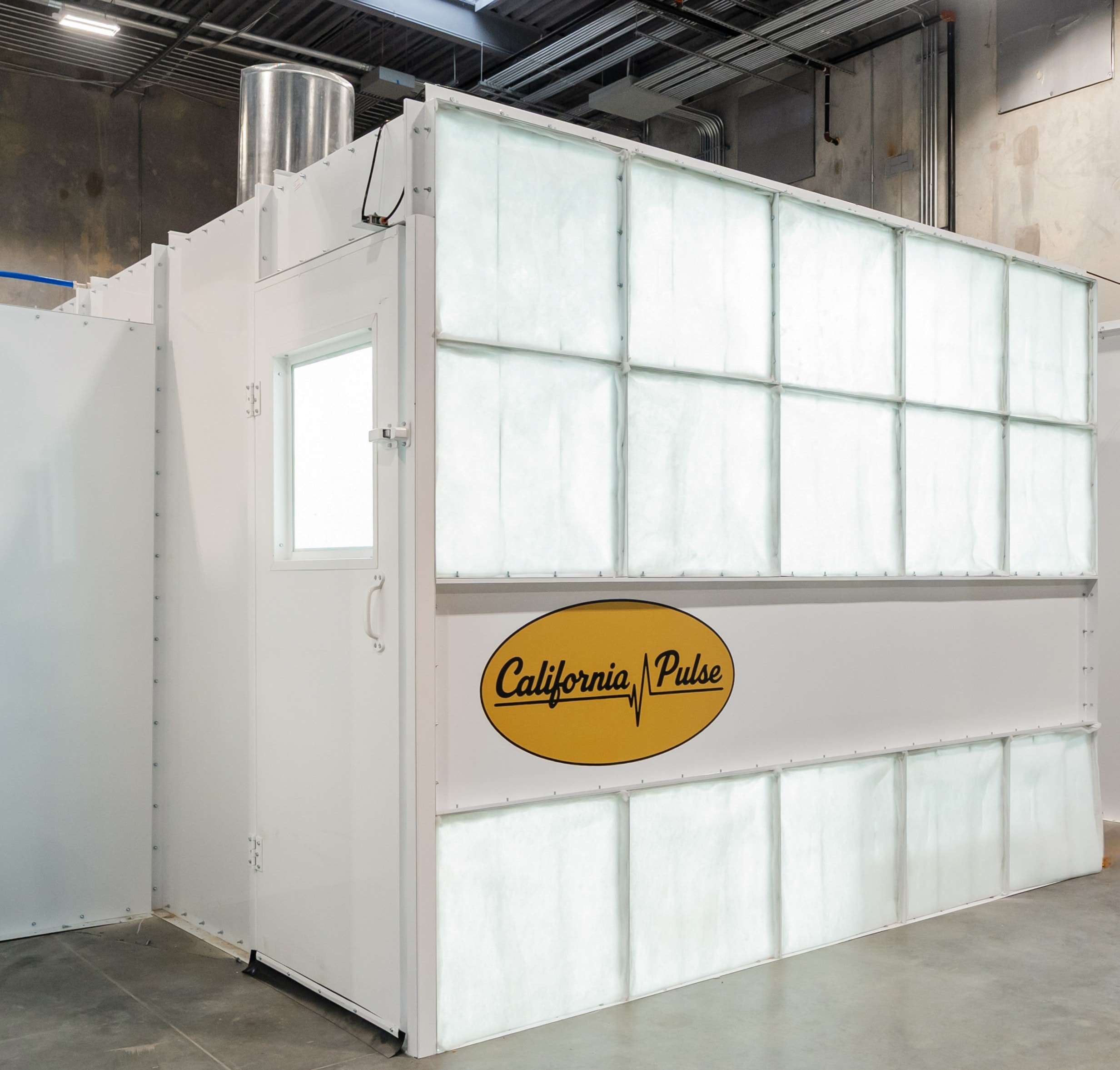 Paint mixing roomsVentilated, code-compliant rooms for storing and mixing flammable coatings.
Ready to build a custom solution for your business?
Before you specify
Worth reading first
- Spray Booth Ventilation RequirementsIntake and exhaust, airflow patterns, pressure balance, filtration, air makeup, and the ventilation mistakes worth avoiding.
- NFPA 33 for spray finishingVentilation, electrical classification, and the spray area boundary explained.
- Industrial finishing overviewPowder and liquid coating compared, with the equipment each process needs.