

California Pulse
Composite Finishing
Composite finishing covers the surface work on fiberglass, carbon fiber, and other reinforced plastic parts — marine hulls and decks, aerospace structures and fairings, wind and transit components, tanks, body panels, and architectural elements. The coatings themselves are conventional gelcoats, primers, and topcoats, and the spray equipment resembles any other liquid finishing setup.
What makes composite work different is everything between the coats. Composite surfaces come off the mold with porosity, print-through, and imperfections that have to be filled and faired flat, and that means long cycles of aggressive sanding. A composite shop generates more fine dust than any other kind of finishing operation, and the dust is the design problem the equipment has to solve — not the spray.
The composite finishing sequence
Gelcoat or primer application
In open molding, gelcoat is sprayed into the mold before the laminate, so the finished surface is formed against the tool. In secondary finishing, a high-build primer or surfacer is sprayed onto the demolded part to fill porosity and provide material to sand back. Both are heavy-bodied, high-build materials applied at film thicknesses well beyond a normal topcoat, which changes gun selection, fluid delivery, and the amount of overspray the booth has to handle.
Fairing and filling
Fairing compound is applied over the primer to correct contour — flattening print-through, low spots, and joints so the surface reads as a single continuous form under gloss. On large marine parts this is the most labor-intensive stage of the entire build, and the great majority of that compound is subsequently sanded off. Where it ends up is an equipment question.
Sanding
Repeated cycles of sanding and re-priming bring the surface to the required flatness. This is where composite finishing diverges most sharply from metal work: the dust volume is high, the particles are fine and airborne, and they will settle into any wet finish anywhere nearby. Uncontrolled sanding dust is simultaneously a finish-quality problem, a housekeeping problem, and an operator exposure problem, which is why downdraft prep stations and sanding enclosures are core composite equipment rather than accessories.
Topcoat and cure
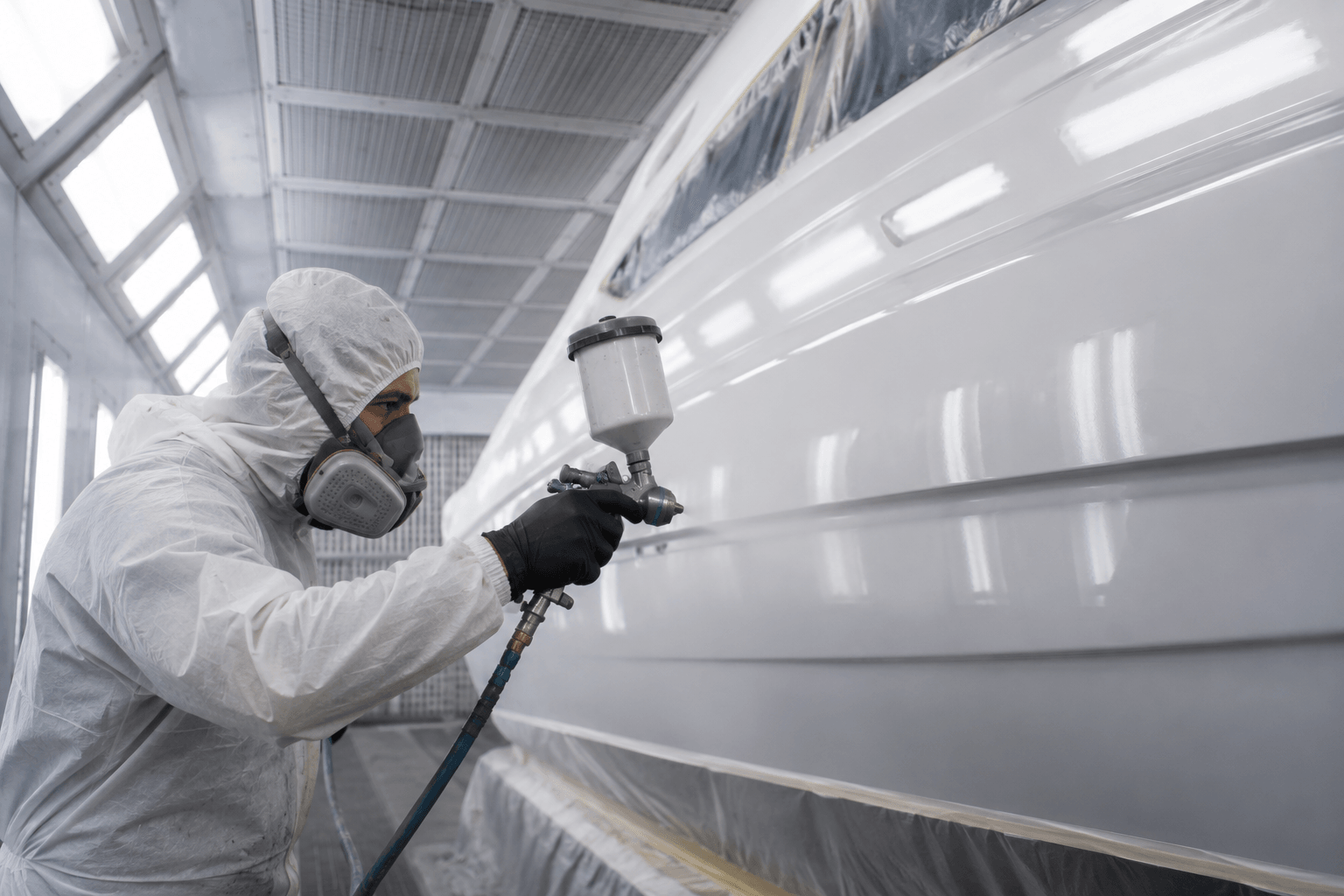
The finish coat is sprayed in a filtered, controlled enclosure. Composites are cured at low temperature or ambient, never at powder-coating temperatures — resin systems have a glass transition temperature above which the part distorts, and thermal expansion mismatch between resin and reinforcement can telegraph the fibre pattern through a finished surface. Force dry cycles for composite topcoats are correspondingly gentle and closely controlled.
Equipment for composite finishing
Downdraft prep stations
A prep station gives sanding and fairing work a dedicated, ventilated area that pulls dust down and away from the part and the operator rather than letting it circulate. It keeps dust-generating work out of the spray booth — which protects both the booth's filters and the finish quality of whatever is being sprayed elsewhere — and it does so without occupying a full booth for an operation that does not need one.
Sanding and dust collection
High sanding volumes call for dedicated dust collection, sized to the number of operators and tools working at once. Point-of-tool extraction captures dust at the source; enclosure and ambient capture handle what escapes. Filter media and collector selection follow from the dust being generated, and composite dust deserves the same care in collector design that any fine combustible particulate does.
Spray booths sized to the part
Composite parts are frequently large and awkward — hulls, tanks, structural panels, transit body sections — and the enclosure has to be built around the part rather than chosen from a size chart. California Pulse builds booths for marine, aerospace, rail and transit, and industrial composite work, including outdoor and container-based enclosures where a permanent building addition is not practical.
Lighting
Fairing work is judged by eye, and a defect that cannot be seen cannot be corrected. Composite finishing benefits from higher light levels and better light placement than most industrial finishing — enough illumination to read surface contour along the length of a large part, not merely enough to see the work.
Emissions, exposure, and compliance
Composite finishing raises two regulatory issues at once. Open molding and gelcoat spraying release styrene, which is both an air emission and an occupational exposure concern with its own OSHA permissible exposure limit. Fiberglass and composite dust from sanding is a separate exposure concern requiring capture at source and appropriate respiratory protection. Federal emissions requirements for reinforced plastic composites production apply to many facilities, alongside your California air district's VOC rules for the coatings themselves.
The safety-code track is the same as for any spray finishing: application of flammable and combustible materials is evaluated against NFPA 33, together with OSHA general industry standards and the electrical and mechanical codes adopted locally, with any force dry or bake operation potentially bringing NFPA 86 into scope. As always, the Authority Having Jurisdiction has the final say on the installed system.
Compare composite finishing with powder, liquid, and waterborne processes.
Marine and yacht finishing systems built around the part.