Powder Coating Guide
Powder Booth Filtration: Collection, Reclaim, and Final Filters
Filtration is the part of a powder system that quietly decides how well everything else works. It sets whether overspray comes back as usable powder or goes into a drum, how much fan energy you buy every month, how fast the booth can be cleaned for a color change, and how much of the combustible dust risk is engineered out rather than managed by procedure.
It is also the part most often specified by looking at a filter count rather than at the job the filters do. This guide walks the air from the booth opening to the point where it is discharged or returned, and explains what each stage is for.
Quick Answer
Powder booth filtration is a staged system, not a single filter. Airflow carries overspray from the booth into a collection module, where cartridge filters or a cyclone separate the powder from the air. On a recovery system that powder is sieved and returned to the feed hopper; on a spray to waste system it goes to a container. Cartridges are surface loading media cleaned in place by pulses of compressed air, so they release their load rather than accumulating it. Downstream of collection, final or safety filters protect the space the air is discharged into. Performance is monitored by pressure drop across the stages, and filtration is sized around the booth's airflow rather than around the physical size of the module.
What powder filtration is for
A powder booth's filtration does three separate things, and they are worth separating because they are sized and maintained differently.
- Separation. Take the powder out of the air stream. This is the collection module, and on a recovery system it is also the reclaim mechanism.
- Protection. Keep powder out of the fan, the ducting, and whatever the air is discharged into. This is the final or safety stage.
- Containment. Provide the pressure drop and airflow the booth needs to hold powder inside the enclosure in the first place.
That third one surprises people. Filters are part of the airflow design, not an accessory bolted to it. When filters load up, airflow falls, and containment at the booth openings goes with it. That is why filter condition is a process variable and not a housekeeping detail.
The collection train, stage by stage
On a typical powder system, the air takes this path:
| Stage | What happens | Sized by |
|---|---|---|
| Booth openings | Face velocity contains charged powder inside the enclosure | Open area and booth type |
| Ducting or plenum | Overspray is conveyed to collection, kept in suspension | Conveying velocity |
| Collection module | Powder is separated from the air by cartridges or a cyclone | Booth airflow and dust loading |
| Reclaim path | Separated powder is sieved and returned to the hopper | Volume and color change routine |
| Final or safety filter | Residual particulate is captured before discharge | Where the air goes |
| Fan and discharge | Air is moved and released or returned | Total system resistance |
Every stage adds resistance, and the fan has to be selected for the sum of it, including filters at their dirty condition rather than clean. A system sized on clean filter pressure drop runs out of airflow long before the filters are due for change.
Cartridge modules and pulse cleaning
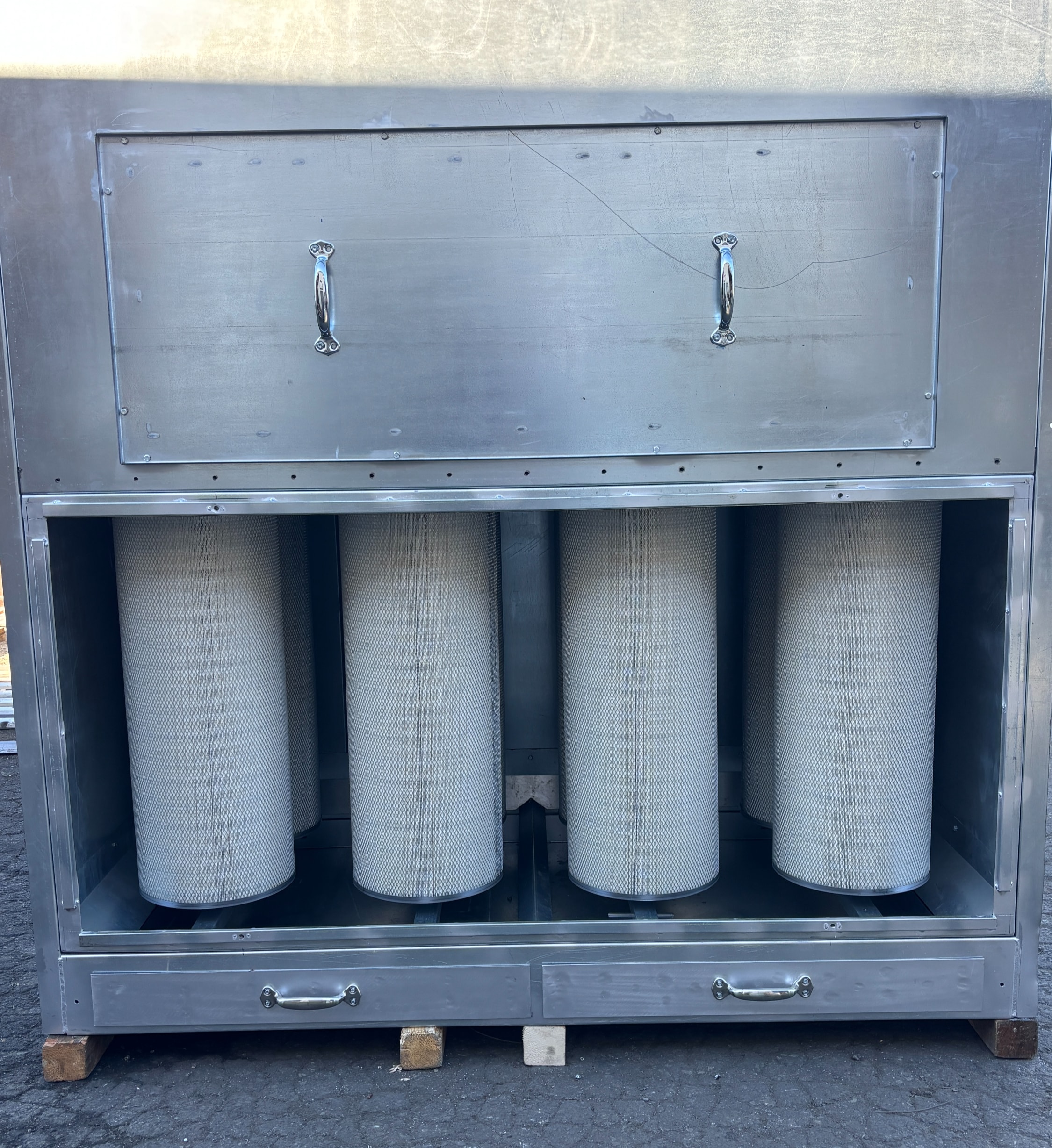
The most common powder collection arrangement is a bank of cartridge filters mounted to or adjacent to the booth.
Cartridge media is pleated to pack a large surface area into a small volume, and it is designed to load on the surface rather than deep in the media. That matters because it is what allows the cartridge to be cleaned in place: a short pulse of compressed air fired back through the cartridge releases the collected powder, which falls into a hopper below and, on a recovery system, goes on to be sieved and reused.
Two practical consequences follow. First, compressed air quality is a real specification: oil or moisture in the pulse air contaminates both the media and the reclaimed powder. Second, pulse cleaning does not restore a cartridge indefinitely. Media gradually blinds, pressure drop climbs, and eventually the cartridge is replaced. Tracking that trend is how you plan filter spend instead of being surprised by it.
Cyclones and where they fit
A cyclone separates powder from air by spinning the air stream so that the heavier particles are thrown out of the flow, with no media involved in that first stage.
Cyclones are used ahead of a cartridge after filter on larger systems, particularly where color change speed matters. A cyclone has no media to purge, so the primary separation stage can be cleaned down faster than a bank of loaded cartridges, and the cartridges downstream see a much lighter load and last longer.
The trade is footprint, height, and capital cost. A cyclone plus after filter is a larger installation than a cartridge module bolted to the back of a booth, and it makes sense at volume or where fast color change is the operating constraint. For most batch and mid volume shops, a cartridge module is the practical answer.
Final filters and where the air goes
After collection, there is still a stage between the system and wherever the air ends up. What that stage needs to be depends entirely on the destination.
Air discharged outdoors is subject to your air district's requirements and the AHJ's review. Air returned into the building has to be clean enough that you are not slowly distributing powder through the plant, which is where higher efficiency final filtration comes in.
This is also where the words HEPA and cartridge get used as if they were competing options. They are not: cartridges do the primary separation, and a final filter is a different stage doing a different job. That distinction is worked through in cartridge filters versus HEPA filters, including when a final stage is genuinely required and what it costs in fan energy.
Pressure drop, monitoring, and airflow over time
A powder system's performance drifts, and pressure drop is how you see it happening.
As cartridges load, resistance rises and airflow falls. Containment at the booth openings weakens, conveying velocity in the ducting drops, and powder starts settling where it should not. None of this announces itself. It shows up as dust on the floor near the booth, as coverage problems, and eventually as a housekeeping and safety issue.
The fix is instrumentation and a routine: monitor differential pressure across the collection stage, log it, know what normal looks like for your system, and act on the trend rather than the crisis. Where a system uses variable frequency drives on the fan, it can hold airflow as filters load, which smooths performance and saves energy, but it also masks the drift, so monitoring matters more rather than less.
Filtration and combustible dust
Powder is a combustible dust, and the collection module is where the highest concentration of it lives. Filtration design carries a share of the safety engineering as a result.
In practice that shows up as bonding and grounding of the module, ducting, and every conductive component in the path; control of ignition sources; and interlocks so that application cannot run when the collection airflow is not present. It also shows up in housekeeping requirements around the equipment, because accumulated dust outside the system is part of the same hazard.
The applicable requirements come from the standards addressing spray application and combustible particulate solids, and the practical determination is made by your authority having jurisdiction. See the powder coating compliance guide and codes and compliance for how that review usually runs.
Filtration and color change
The filtration arrangement is the largest single factor in how long a color change takes.
Reclaiming means the whole path from booth to hopper holds powder of the old color, and every part of it has to be purged or cleaned before the new color runs. Spraying to waste shortens that dramatically at the cost of material.
Shops that run many colors in short runs often use a smaller dedicated module, or spray to waste for short runs and reclaim only their high volume colors. Shops running one or two colors in long runs should optimize the other way, for reclaim efficiency and filter life. The economics of that decision are the subject of recovery versus non-recovery systems.
Maintenance and consumables
Filtration is the part of a powder system with an ongoing bill, and it is worth planning rather than absorbing:
- Cartridges, tracked by pressure drop trend rather than by calendar alone
- Final or safety filters where fitted
- Compressed air quality for pulse cleaning, including dryers and filtration on the air supply
- Hopper emptying and powder handling routine
- Housekeeping around and under the equipment
- Sieve screens and reclaim path cleaning if you reclaim
Access is what makes all of this survivable. A module you can open, reach into, and change cartridges in without dismantling ducting is one that actually gets maintained. That is a design decision, made once, that affects every week of the system's life. Preventive maintenance covers how we structure that work.
Specifying filtration properly
Bring these to the conversation and the filtration can be engineered rather than guessed:
- Booth type, size, and opening dimensions, which set the airflow
- Powder volume sprayed per shift and the number of colors
- Whether you intend to reclaim, spray to waste, or both
- Where the air will be discharged, and whether any of it returns to the building
- Available floor space and ceiling height around the booth
- Compressed air supply available for pulse cleaning
- Your air district and authority having jurisdiction
With those, the collection stage, the final stage, and the fan are sized as one system against dirty filter conditions rather than clean, which is the difference between a system that holds performance and one that only worked on day one.
From California Pulse
Related equipment & services
Answers
Frequently asked questions
Still have a question about your project? Send it with your details and our engineers will answer it in writing.
How does powder booth filtration work?
How often do powder booth filters need changing?
What happens if powder booth filters get clogged?
Do I need a cyclone or a cartridge module?
Why does compressed air quality matter for powder filtration?
Is powder booth filtration a combustible dust concern?
Keep Reading
Related resources
Cartridge vs HEPA Filters
Why these are stages rather than alternatives, where each belongs in the collection train, and when a high efficiency final filter is genuinely required.
Read GuideRecovery vs Non-Recovery
What reclaim really saves, what it costs in color change time and labor, and how part mix decides between recovery and spray to waste.
Read GuidePowder Coating Booth Design
Open face versus enclosed, airflow and containment, interior surfaces, grounding, and how color change strategy shapes the booth before it is built.
Read GuidePowder Coating Compliance Guide
NFPA 33 and 86, combustible dust, electrical, OSHA, ETL listing, and air district review, in the order they come up on a real project.
Read Guide
Back to the Spray Booth & Finishing Systems Resources hub.
Specify filtration around the work, not the catalogue
Tell us your booth size, powder volume, color mix, and where the air goes. We will size the collection, the final stage, and the fan as one system.