Powder Coating Guide
Powder Coating Booth Design: Layout, Airflow, and Color Change
A powder booth looks simpler than a liquid spray booth. There is no solvent to dilute, no flash-off to manage, and in most cases no heat in the booth itself. That simplicity is misleading. A powder booth has to do something a liquid booth never attempts: capture the material that misses the part in a condition clean enough to spray again, and then let you change color without contaminating the next job.
Everything in the design follows from those two demands, plus the fact that powder is a combustible dust. This guide walks through the decisions in the order they get made, so you can tell the difference between a booth engineered for your work and an enclosure with a fan on it.
Quick Answer
Powder coating booth design is set by the part, the collection method, and the color change strategy. The booth is sized around the largest part plus gun reach and operator movement on every surface that has to be coated, then given enough airflow through the openings to contain overspray and carry it to the collection module. Interior surfaces are specified smooth and ledge free so powder does not accumulate and cleandown is quick. Every conductive component is bonded and grounded because powder is a combustible dust. Open face booths suit batch work and manual application, enclosed booths with entry and exit openings suit conveyorized lines, and shops running many colors specify the booth around cleandown time rather than around footprint.
What a powder booth actually has to do
Three jobs, in this order:
- Contain. Keep charged powder inside the enclosure and off the rest of the plant, off the operator, and off parts waiting to be coated.
- Convey. Move the overspray to the collection module in usable condition, using airflow rather than gravity.
- Release. Come clean quickly, so a color change or a shift change does not cost an hour.
A liquid booth only has to do the first two, and it does not care what condition the overspray is in when it reaches the filters. That is the reason a powder booth is not simply a spray booth with different filters, and the reason a converted liquid booth usually disappoints: it was built to trap overspray, not to give it back.
Everything below is a consequence of those three jobs. If a design decision does not serve containment, conveying, or cleandown, it is decoration.
Open face or enclosed
The first fork in the road is how the part gets in and out.
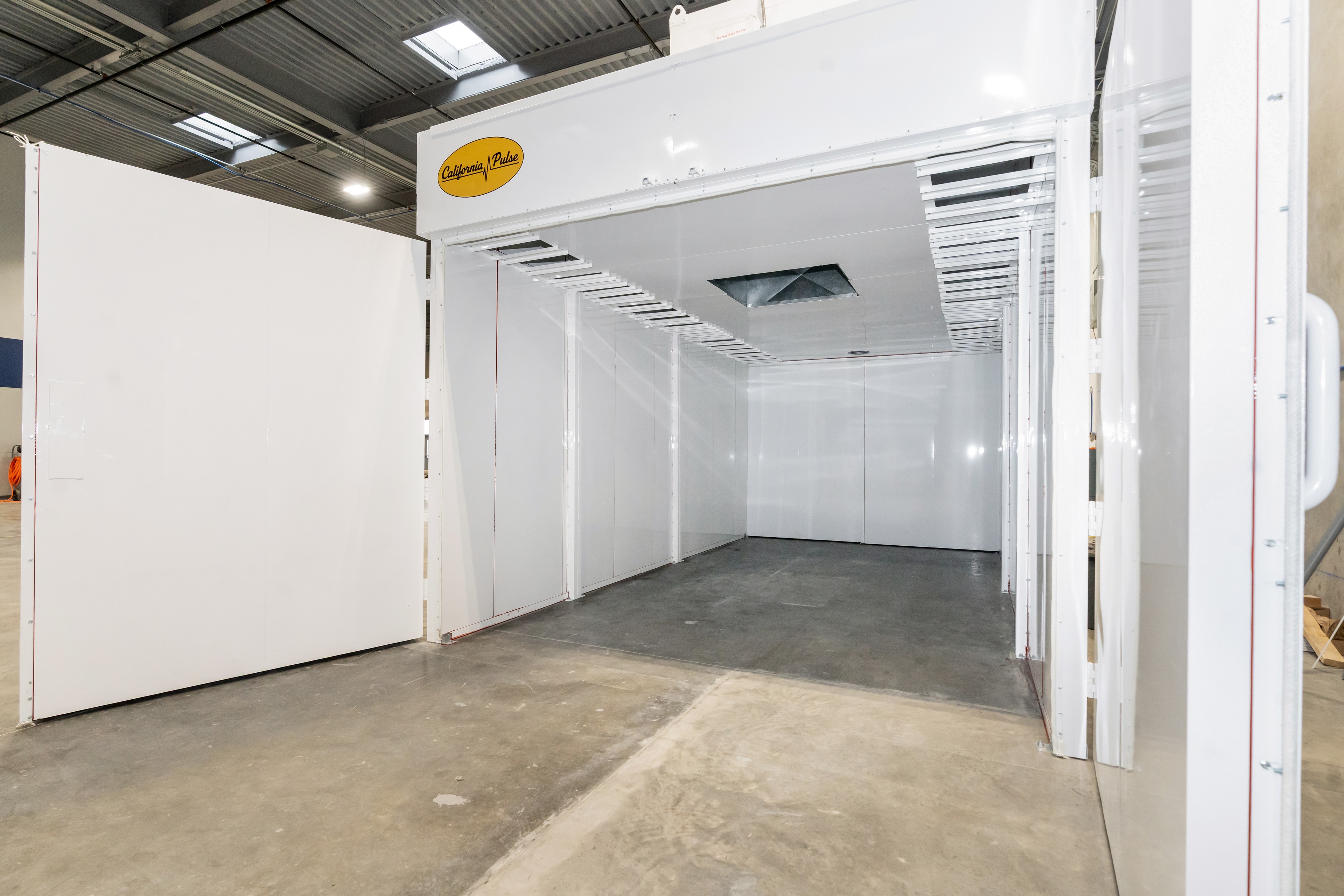
Open face booths have one large open side. The operator works from the front, parts come in on a cart or a hanger, and the airflow moves from the open face back through the collection wall. They suit batch work, a wide part mix, manual application, and shops where flexibility matters more than throughput. They are also the cheaper and smaller of the two, and they are the usual starting point for a shop adding powder for the first time.
Enclosed booths have a defined entry and exit, usually for a conveyor to carry parts through. Airflow is contained on both ends, the operator or the automatic guns work from the sides, and the booth becomes part of a line rather than a station. They suit high volume of similar parts and pair with a conveyor system and an inline oven.
The choice is not really about the booth. It is about whether your work is batch or continuous, which is the subject of conveyorized versus batch powder systems. Decide that first, because it also determines the oven, the floor space, and the labor model.
Airflow and containment
Powder is held on the part by an electrostatic charge, not by air. The booth's air does a different job: it captures the powder that never landed and carries it to collection, and it keeps a face velocity across the openings that stops charged powder drifting out into the shop.
Two consequences fall out of that:
Too little air and you lose containment. Powder escapes the openings, settles on the floor and the surrounding equipment, and the shop develops a dust housekeeping problem that is also a safety problem. Too much air and you start pulling powder off the part before the charge holds it, which shows as thin coverage and poor edge build, and you pay for the extra fan energy and filter loading forever.
The right volume is a function of the open area, the booth type, and how the guns are used, and it is set during design rather than dialed in later. It also drives everything downstream: fan and motor size, cartridge count, ducting, and the electrical service. The same logic applies on the liquid side, and the mechanics are covered in spray booth ventilation requirements.
Interior surfaces and cleanability
In a powder booth the interior finish is a process decision, not a cosmetic one.
Every ledge, fastener head, seam, and internal corner is somewhere powder can sit. That accumulation is both a color change problem and a combustible dust problem. Booths intended for frequent color change are built with smooth continuous interior surfaces, minimal internal structure, radiused corners where practical, and no horizontal ledges inside the airflow path.
Material choice follows the same reasoning. Steel booths are durable and straightforward to ground. Non conductive plastic or composite liners are used where fast cleandown matters most, because powder releases from them readily, but they bring their own grounding and static requirements that have to be engineered rather than assumed. Neither is universally correct. The question is how many colors you run and how fast you have to switch.
Grounding, bonding, and static control
Powder is a combustible dust, and the booth is where the dust and the charge are in the same place. That makes bonding and grounding the single most important safety detail in the design, and it happens to be the most important quality detail as well.
On the safety side, every conductive component in and around the booth is bonded and grounded so that charge cannot accumulate and discharge. That includes the booth structure, the collection module, ducting, hangers, carts, and the part itself.
On the quality side, grounding is what makes the coating work. A part hanging on a hook coated with cured powder is not grounded, and the result is thin coverage, back ionization, orange peel, and rework. Shops that fight persistent quality problems in powder are usually fighting a grounding problem, which is why hook cleaning is a production task rather than a maintenance afterthought. The compliance framework around this is covered in the powder coating compliance guide.
Integrating the collection module
The booth and the collection module are one system, and specifying them separately is how shops end up with a booth that cannot reclaim.
The common arrangements are a cartridge module mounted directly to the booth, which is compact and suits most batch and mid volume work, and a cyclone ahead of an after filter, which suits high volume single color or fast color change on larger systems. Which one belongs on your booth depends on volume, number of colors, and whether you intend to reclaim at all.
That decision is worth making deliberately, because it changes the booth's footprint, the ducting, the cleandown routine, and the running cost. Powder booth filtration covers the collection train in detail, and recovery versus non-recovery systems covers whether reclaim is right for your part mix in the first place.
Sizing the booth around the part
Size the booth around the largest part you actually intend to run, then add what the process needs around it:
- Clearance on every surface that has to be coated, for gun reach and for the operator to move
- The fixture, cart, or hanger the part travels on, which is often larger than the part
- Room for the part to be presented at the angle the coating requires, not just to fit through the door
- Openings sized for the part plus the fixture plus handling clearance
A booth that fits the part but not the gun hand is a booth that produces rework. A booth sized generously beyond that costs air, filters, and floor space for its whole service life. The same principle governs liquid booths and is worked through in industrial spray booth sizes.
Remember that the oven has to accept the same part with clearance for air circulation. Booth and oven envelopes are specified together or one of them ends up wrong, which is the subject of powder coating oven sizing.
Designing for color change
Color change is the operating cost nobody budgets for and the design constraint that separates booths that work from booths that frustrate.
If you run one color, or a few colors in long runs, cleandown speed barely matters and you should optimize for reclaim efficiency and footprint instead. If you run many colors in short runs, cleandown time is your real capacity limit, and it should drive booth material, interior geometry, module selection, and whether you reclaim at all.
Shops with a wide color mix often find spray to waste faster overall, because sieving, purging, and cleaning the reclaim path for every change costs more than the powder saved. Others run a dedicated module or a second collection unit for their high volume color and spray the rest to waste. There is no universally right answer, only the one that matches your order book.
Lighting, access, and the operator
Powder is applied by eye. The operator has to see film build, coverage on edges, and faraday cage areas while spraying a material that has almost no wet look to guide them. Lighting quality directly affects first pass yield, and fixture placement and rating are set by the booth's size and classification rather than by preference. LED booth lighting covers the fixture side.
Access matters as much. Where the operator stands, how the cart rolls in, how far the gun hose reaches, and how the booth is entered for cleandown all decide whether the design is pleasant to work in every day. These details cost nothing to get right during design and cannot be changed afterward.
Finally, plan the space around the booth: powder storage and sieving, the hopper and pump, part staging before and after, and the route to the oven. A booth that works in isolation and blocks the aisle has not solved anything.
What to settle before you specify a booth
- The largest part, with dimensions, weight, and how it hangs or sits
- The fixture or cart it travels on
- Batch or conveyorized, and the throughput you need per shift
- How many colors, and how often you change them
- Whether you will reclaim, spray to waste, or both
- Where the oven goes and how parts get from booth to oven
- Available floor space, ceiling height, and electrical service
- Your authority having jurisdiction and any local requirement you already know about
With those answers, a booth can be engineered rather than selected. Without them, any booth is a guess. Custom design explains how we approach that engineering, and powder coating ovens and booths covers the equipment we build.
From California Pulse
Related equipment & services
Powder Coating Ovens & Booths
The powder application and cure equipment we manufacture.
ViewPowder Coating Process
How the process works end to end, from pretreatment to cure.
ViewCustom Design
Engineering a booth around your part, building, and color mix.
ViewDust Collectors
Collection equipment for powder and dry particulate.
ViewAnswers
Frequently asked questions
Still have a question about your project? Send it with your details and our engineers will answer it in writing.
What is the difference between a powder coating booth and a paint booth?
Should I choose an open face or an enclosed powder booth?
How much airflow does a powder coating booth need?
Why does grounding matter so much in a powder booth?
How do I design a powder booth for fast color change?
How big should my powder coating booth be?
Keep Reading
Related resources
Powder Booth Filtration
The collection train from booth to final filter, how cartridges and pulse cleaning work, and the pressure drop and maintenance that decide performance.
Read GuideRecovery vs Non-Recovery
What reclaim really saves, what it costs in color change time and labor, and how part mix decides between recovery and spray to waste.
Read GuideConveyorized vs Batch Systems
How the two models differ in capital, space, labor, and flexibility, and why part mix decides the crossover point as much as volume does.
Read GuidePowder Coating Oven Sizing
Working envelope, heat load, and cycle time, and why metal temperature rather than air temperature decides whether a part is really cured.
Read Guide
Back to the Spray Booth & Finishing Systems Resources hub.
Planning a powder booth?
Send us your largest part, your color mix, and how parts move through the shop. Our engineers will specify the booth, the collection, and the oven as one system and quote it in writing.