Spray Booths Guide
Industrial Spray Booth Sizes: How to Size a Booth Correctly
Spray booth sizing looks like a simple measurement exercise and rarely is. The interior has to hold the part, the space the operator needs to move around it, the equipment used to get it in and out, and the airflow pattern the finish requires. Undersize any of those and the booth restricts the shop for its entire service life. Oversize it and you pay for the excess air volume every hour the booth runs.
This guide covers how to arrive at dimensions that reflect the work rather than a round number.
Quick Answer
Size an industrial spray booth by starting with the largest part you will realistically finish, then adding working clearance on all sides for the operator, the spray equipment, and the airflow pattern. Confirm that door openings accommodate the part plus whatever moves it, whether that is a forklift, a cart, a crane, or a driver in a cab. Check the result against your building's usable footprint, ceiling height, and column positions, then against your workflow so the booth does not become a bottleneck. Finally, consider what you expect to finish over the booth's service life, because enlarging a booth later is usually impractical. Custom sizing is often preferable in industrial work because a booth built to the part avoids paying to heat and move air around space you never use.
Start with the part, not the booth
Work in this order and the dimensions arrive on their own:
- The largest part you will realistically finish. Not the largest you have ever quoted, and not the average. The honest upper bound of regular work.
- How it sits in the booth. On the floor, on a cart, on a fixture, hung from a crane, or driven in. The support method takes up space and changes the effective envelope.
- What the operator needs. Room to reach every surface at a workable gun distance, room to walk the full perimeter, and room to move without contacting wet coating.
- What the airflow needs. Air must reach all surfaces of the part. A part that fills the cross section blocks the airflow pattern the booth depends on.
Only after those four does a nominal booth dimension mean anything.
Working clearance
Clearance is the dimension most often cut to save money and most often regretted. It has to account for several things at once:
- Operator access on every side that gets sprayed, at a workable distance from the surface
- The spray equipment itself, including hose or cable management
- Movement of the part if it has to be rotated or repositioned
- Airflow that reaches all surfaces rather than being blocked by the part
- Lighting angles, because a part crowded against a wall shadows its own surfaces
Clearance requirements differ by part and by process, so treat any published clearance figure as an example rather than a rule. What matters is that the clearance is derived from your part and your handling method, and confirmed on a layout drawing before fabrication.
Door openings and access
A booth is only as usable as its opening. The door has to pass the part plus whatever carries it, and that combination is usually larger than the part alone.
Things that regularly catch projects out:
- Forklift mast height when the part is carried in, which can exceed the part height considerably
- Crane or hoist clearance above the part, which sets the required ceiling height
- Cart and fixture height, which raises the part off the floor
- Antennas, mirrors, exhaust stacks, and attachments on vehicles and equipment
- Turning radius and approach angle outside the booth, since a door wide enough for a straight entry may not be enough for an angled one
- Whether doors swing into usable space or need clearance of their own
Door configuration also affects airflow and sealing, so it is a design decision rather than an accessory choice.
How sizing differs by application
Different industries push booth dimensions in different directions, which is why standard sizes fit some work well and others badly.
| Application | What usually drives the size |
|---|---|
| Automotive refinishing | Vehicle envelope plus perimeter access, with downdraft airflow favouring pit or raised floor work. See automotive spray booths |
| Trucks and large vehicles | Overall length and height including stacks and mirrors, plus drive-through access at both ends. See truck and large equipment booths |
| Heavy and construction equipment | Weight and floor loading, boom and attachment reach, and forklift or crane access. See construction and agriculture |
| Machinery and fabricated assemblies | Awkward geometry, hanging or fixturing needs, and crane clearance. See industrial manufacturing |
| Aerospace | Component envelope, cleanliness requirements, and controlled conditions. See aerospace and defense |
| Rail and transit | Exceptional length, often with drive-through or track access. See rail and transit |
| Marine | Hull height and beam, and handling equipment clearance. See marine and yacht |
Where the work spans several of these, the booth is usually engineered around the constraint that binds hardest rather than around any single part.
Facility constraints
The building limits the booth as much as the part does. Check all of these before settling on dimensions:
- Usable floor area, not gross area, once aisles, storage, and other equipment are accounted for
- Ceiling height, including the clear height under joists, ducting, sprinkler lines, and lighting
- Column positions, which frequently dictate where a booth can actually sit
- Floor construction and loading, particularly for heavy parts or where a pit is required
- Route from the door to the booth, since a part that fits the booth still has to reach it
- Space around the booth for filter changes, fan service, and door swing
- Where exhaust can reach the outside, and where the discharge can legally terminate
If the building is the binding constraint, an outdoor spray booth is often the better answer than compressing the booth to fit. Indoor versus outdoor spray booths works through that decision.
Workflow and throughput
A booth sized correctly for the part can still be sized wrongly for the shop. If spraying, flash, and cure all happen in the same enclosure, the booth is occupied for the entire cycle and throughput is capped by the slowest stage.
Ask how many parts have to move through per shift, whether prep and sanding can be moved out of the booth into a prep station, whether mixing belongs in a separate mixing room, and whether cure should be separated so the booth is released sooner. Often the right answer is a slightly smaller booth plus supporting equipment rather than one large booth doing every stage.
Planning for future work
A spray booth is a long-lived asset, and its dimensions are effectively fixed once installed. Enlarging one later usually means structural work, new airflow and heating calculations, revised electrical work, and a fresh permit, which frequently costs more than building the right size initially.
Worth weighing during design:
- Parts you expect to take on within the booth's service life
- Growth in the size of your customers' equipment
- Whether an adjacent bay or the site could accommodate an extension later
- Whether the airflow and heating equipment has headroom, since these are as difficult to enlarge as the structure
The counterweight is operating cost. A larger booth moves and heats more air permanently. The judgement is between plausible future work and a fixed running cost, which is exactly the trade to have with an engineer before fabrication.
Why custom sizing often wins in industrial work
Standard sizes exist because they suit common applications well, and where one genuinely fits your part it is a sound choice.
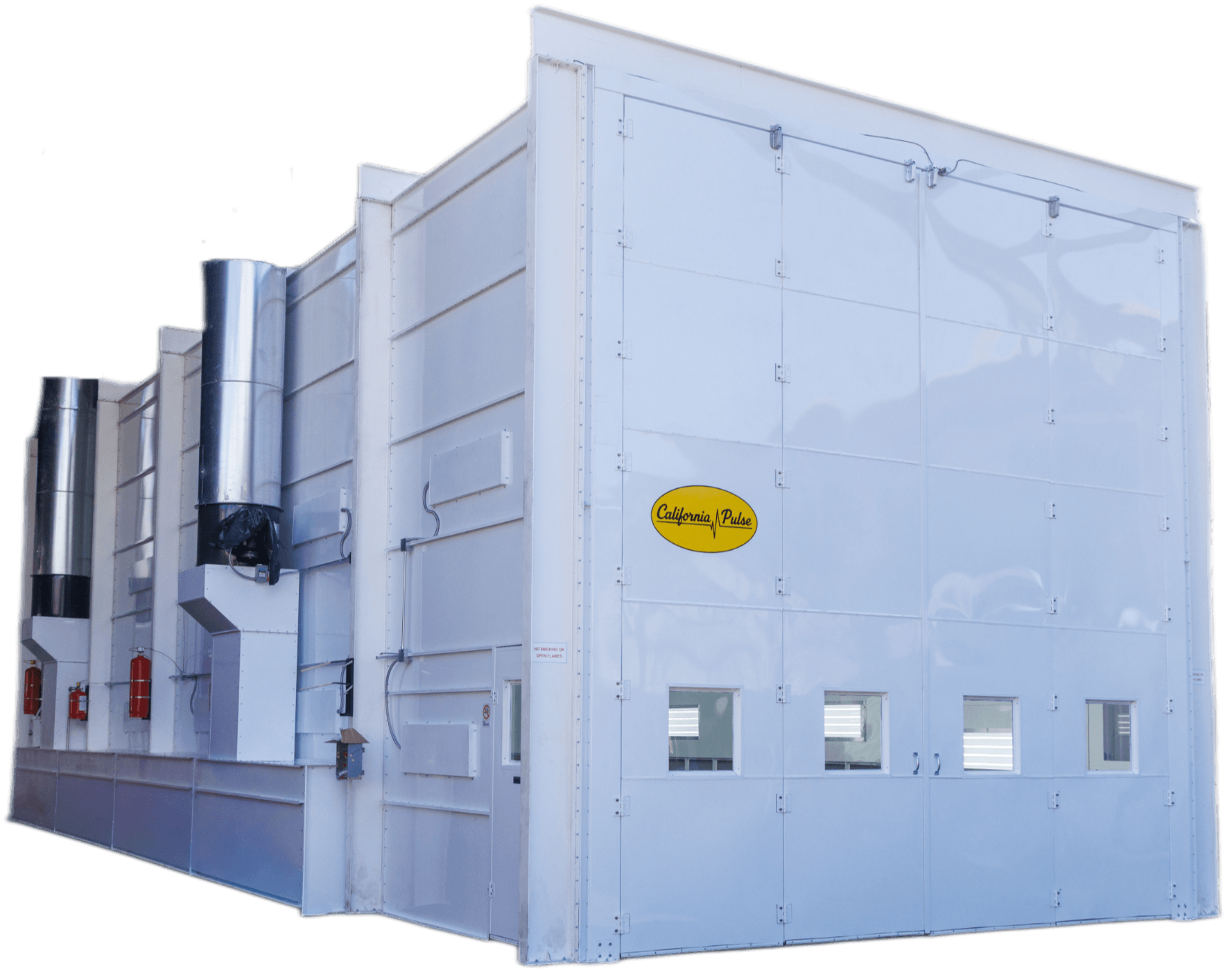
Industrial work frequently falls outside those envelopes. Parts are long, tall, heavy, awkwardly shaped, or handled by equipment that a standard opening was never drawn around. In those cases a standard booth is either too small, which limits the shop, or considerably too large, which means paying to move and heat air around empty space for the booth's whole life.
A booth engineered to your part avoids both. That is the argument for custom spray booth design, and it is why every California Pulse system is engineered around a specific part, building, and process rather than adapted from a catalogue.
From California Pulse
Related equipment & services
Truck & Large Equipment Booths
Booths sized for full size vehicles and heavy equipment.
ViewAutomotive Spray Booths
Enclosed booths for vehicle refinishing work.
ViewCustom Design
Systems engineered around your part and your building.
ViewConveyor & Crane Systems
Moving heavy or awkward parts in and out.
ViewAnswers
Frequently asked questions
Still have a question about your project? Send it with your details and our engineers will answer it in writing.
What size spray booth do I need?
How much clearance do I need around the part?
Should I buy a bigger booth than I need now?
What size door opening does a spray booth need?
Are custom size spray booths better than standard sizes?
Can a spray booth be made bigger later?
Keep Reading
Related resources
How to Choose an Industrial Spray Booth
The complete buyer's guide. Twelve decisions in the order they should be made, from the part you finish to the manufacturer you choose.
Read GuideIndustrial Spray Booth Cost
The variables that move spray booth pricing, why a single published price is misleading, and how to build a realistic project budget.
Read GuideIndoor vs Outdoor Spray Booths
Space, weather, structure, installation, maintenance, permitting, and cost compared for both placements.
Read GuideSpray Booth Ventilation Requirements
Intake and exhaust, airflow patterns, pressure balance, filtration, air makeup, and the ventilation mistakes worth avoiding.
Read Guide
Back to the Spray Booth & Finishing Systems Resources hub.
Have your booth drawn around your parts
Send us your largest part, how it is handled, and your building dimensions. We will lay out a booth that fits the work and the space.