Spray Booths Guide
Industrial Spray Booth Requirements
Spray booth requirements are less a single checklist than a set of overlapping obligations: fire and life safety codes, mechanical and building codes, workplace safety rules, environmental permitting, and the manufacturer's own listing and installation instructions. They interact, and the combination that applies to your project depends on what you spray, how much of it, where the booth sits, and who inspects it.
This guide walks the areas that come up on nearly every industrial project, so you know which questions to raise early. It is written to help you plan and to have a better conversation with your authority having jurisdiction. It is not legal advice, and it does not replace the codes that apply to your site.
Quick Answer
An industrial spray booth generally has to satisfy requirements in several areas at once: mechanical ventilation with adequate and continuously maintained airflow, an exhaust system that discharges safely outdoors, filtration that captures overspray, electrical equipment and wiring suitable for the classified area around the spray operation, adequate and properly rated lighting, fire protection appropriate to the process, clearances and separation from ignition sources and combustible construction, interlocks that prevent spraying without ventilation, and permits and inspections from the local authorities. The specific figures and provisions come from standards such as NFPA 33, NFPA 86 where curing is involved, and OSHA's spray finishing rules, as adopted and enforced by your jurisdiction.
Where spray booth requirements come from
Several sources apply at once, and no single document covers everything.
- NFPA 33, the standard for spray application using flammable or combustible materials, is the reference most often cited for booth construction, ventilation, electrical classification, clearances, and interlocks.
- NFPA 86 applies where an oven or cure process is involved, and brings its own requirements for combustion safety, purge, and safety controls. See understanding NFPA 86.
- OSHA regulates the workplace side, including ventilation during spray finishing, respiratory protection, and hazard communication. See OSHA and spray finishing operations.
- Building, mechanical, and fire codes adopted locally govern construction, exhaust, separation, and fire protection.
- Air quality regulations may require permits and control equipment depending on your coatings and volumes.
- The equipment listing and manufacturer instructions are enforceable too. A listed system installed contrary to its instructions is no longer installed as listed.
California Pulse systems are ETL Listed by Intertek and engineered to NFPA 33 and NFPA 86. That gives an inspector a recognised basis to review against, but it does not remove the local approval step. Your authority having jurisdiction makes the final call. Our codes and compliance section covers the standards we build to, and understanding NFPA 33 goes deeper on the spray finishing standard itself.
Ventilation and airflow
Ventilation is the core requirement. A spray booth has to move enough air, in the right direction, continuously, to keep vapour concentrations well below flammable levels and to carry overspray away from the operator and the finish.
Standards set minimum average air velocities, and the applicable figure depends on the booth type, the spray method, and the standard your jurisdiction enforces, so confirm the number that applies to your configuration rather than assuming a value you read elsewhere. What is consistent across configurations is the principle: airflow must be adequate, must be maintained across the whole cross section rather than averaged over a convenient point, and must continue for as long as spraying and the associated vapours are present.
Practical consequences that appear on nearly every project:
- Ventilation must run during spraying, and interlocks are normally required so spray equipment cannot operate without airflow.
- Airflow has to be replaced. A booth exhausting large volumes without adequate makeup air will starve, lose velocity, and can pull combustion products from other equipment in the building.
- Airflow degrades as filters load, so the system needs a way to monitor and maintain it.
Spray booth ventilation requirements covers intake, exhaust, pressure balance, and airflow patterns in detail.
Electrical requirements and area classification
The space inside and immediately around a spray operation is treated as a classified area, because flammable vapours and combustible residues may be present. Electrical equipment, wiring, and fixtures within those areas have to be suitable for the classification, and the extent of the classified area is defined by the applicable standard and the booth configuration.
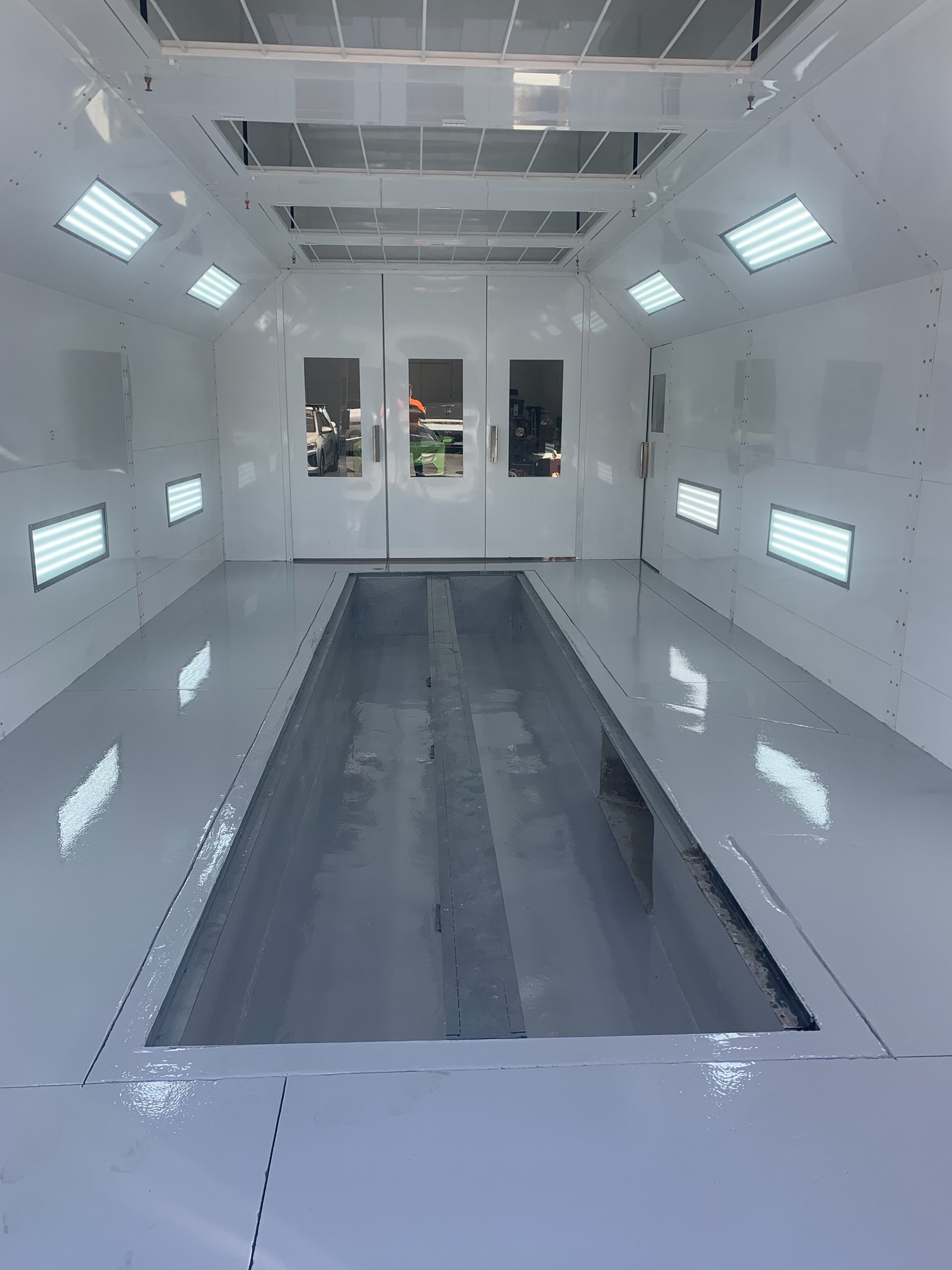
In practical terms this affects fixtures and their placement, wiring methods, motor and drive locations, disconnects, and where ordinary electrical equipment may be installed relative to the booth. It is also the reason lighting is usually installed behind sealed panels rather than mounted inside the spray space.
Separately from classification, the booth has a straightforward load question. Fans, lights, controls, and any electric heating draw power, and the available service at your building has to support them. Confirm your service capacity during design. A control panel can integrate motor control, airflow monitoring, and cycle control, and is where most interlocks live.
Lighting
Lighting has to satisfy two things at once: enough well distributed light for an operator to see the finish, and fixtures suitable for the classified area they sit in.
Fixture count and placement follow booth size and geometry. Light that is adequate on a flat panel is often inadequate on a curved or dark coloured part, and poor lighting shows up later as rework rather than as a code violation. LED booth lighting covers the fixtures we supply and how they are integrated into the booth structure.
Fire protection
Fire protection requirements depend on the process, the materials, the booth, and local code adoption. They commonly involve automatic fire protection for the booth and connected exhaust ducting, appropriate extinguishing agents for the materials in use, and coordination with the building's existing fire protection system.
Two points are worth raising early with your fire authority. First, protection often extends beyond the booth enclosure into the exhaust ducting and plenum. Second, housekeeping is part of the requirement rather than separate from it, because accumulated overspray residue is itself the fuel. That connects directly to the maintenance guide.
Filtration and overspray capture
Filtration serves the finish, the exhaust system, and safety at the same time. Exhaust filters capture overspray so it does not accumulate in the ducting or discharge outdoors, and intake filters keep incoming air clean enough that the coating is not contaminated on the way to the part.
Requirements typically address filter efficiency and suitability for the coating in use, accessible filter locations, and a means of determining when filters need changing rather than relying on memory. Loaded filters reduce airflow, and reduced airflow is a compliance issue as well as a quality one. Powder and liquid processes differ here, so specify filtration against the coating you actually spray.
Exhaust and discharge
Exhaust has to reach the outside safely. Requirements generally address duct construction and support, clearance from combustible construction, access for cleaning, discharge location relative to building openings, air intakes, and property lines, and discharge direction and velocity.
Discharge point is a frequent source of late redesign, particularly on constrained sites and in buildings with rooftop air handling equipment nearby. Establish the discharge location during layout, not after the ducting is fabricated. Air quality permitting may also apply depending on your coatings and volumes, and that is a separate approval from the building and fire permits.
Equipment placement, clearances, and access
Booths need separation from ignition sources and, depending on construction, from combustible building elements. They also need practical clearance that codes do not always specify: room to open doors fully, to change filters, to service fans and motors, and to move parts in and out without contacting the structure.
Plan the surrounding space as part of the booth, including where mixing happens. A mixing room is typically a separate requirement in its own right, and prep stations keep sanding and preparation out of the spray environment.
Permitting and inspection
Most industrial booth installations require permits, and often more than one: building, mechanical, electrical, fire, and sometimes an air quality permit. Plan review usually asks for equipment drawings and listing information, ventilation and airflow calculations, electrical documentation, and a site plan showing the booth, ducting, and discharge.
California Pulse supplies engineered drawings, airflow and ventilation calculations, and electrical documentation with our systems so that submittal package is straightforward to assemble. The review, interpretation, and approval remain with your local authorities. AHJ and permitting covers how that process typically runs, and ETL listed systems explains what the listing does and does not establish.
Why requirements vary between projects
Two shops can install identical booths and face different requirements. The reasons are consistent:
| Variable | Why it changes the requirements |
|---|---|
| Coating and volume | Flammability, vapour generation, and air quality permitting thresholds differ by material and quantity |
| Booth type and configuration | Airflow provisions, classified area extents, and construction requirements follow the booth design |
| Curing or baking | Introduces oven requirements, including combustion safety and purge provisions |
| Building construction | Separation, fire protection, and structural provisions depend on the building it sits in |
| Indoor or outdoor | Weather, structural loading, and discharge considerations change with placement |
| Jurisdiction | Local authorities adopt different code editions and amendments and interpret them independently |
Design around your own combination rather than a general rule, and confirm interpretations with your authority in writing.
From California Pulse
Related equipment & services
Codes & Compliance
The standards our systems are engineered and listed to.
ViewETL Listed Systems
What third party listing establishes, and what it does not.
ViewAHJ & Permitting
Working with the authority having jurisdiction.
ViewInstallation & Commissioning
Getting the system installed, verified, and signed off.
ViewAnswers
Frequently asked questions
What are the basic requirements for an industrial spray booth?
Which codes apply to spray booths?
Does a spray booth need to be permitted?
How much ventilation does a spray booth need?
Does ETL listing mean the booth is automatically approved?
Why do requirements differ between two similar shops?
Keep Reading
Related resources
Spray Booth Ventilation Requirements
Intake and exhaust, airflow patterns, pressure balance, filtration, air makeup, and the ventilation mistakes worth avoiding.
Read GuideHow to Choose an Industrial Spray Booth
The complete buyer's guide. Twelve decisions in the order they should be made, from the part you finish to the manufacturer you choose.
Read GuideIndustrial Spray Booth Cost
The variables that move spray booth pricing, why a single published price is misleading, and how to build a realistic project budget.
Read GuideSpray Booth Maintenance Guide
Filters, fans, exhaust, seals, lighting, controls, overspray, inspection rhythm, and the signs that service is overdue.
Read Guide
Back to the Spray Booth & Finishing Systems Resources hub.
Planning a booth that has to pass inspection
Tell us your jurisdiction and what you finish. We will engineer the system and supply the drawings, airflow calculations, and electrical documentation your plan review will ask for.