Spray Booths Guide
Spray Booth Maintenance Guide
Spray booth maintenance is unglamorous and it is the difference between a system that performs as designed for years and one that quietly drifts until the finish suffers or an inspector raises a finding. The drift is the problem. Airflow degrades slowly, operators adapt without noticing, and by the time a problem is obvious it has usually been present for months.
This guide covers what needs attention, why it matters, and how often, so the work becomes a schedule rather than a reaction.
Quick Answer
Spray booth maintenance centres on keeping airflow at design condition and keeping combustible residue under control. The core tasks are replacing intake, exhaust, and floor filters on a measured schedule rather than by appearance, keeping the booth interior and exhaust plenum free of overspray accumulation, inspecting and cleaning ducting, checking fans, belts, bearings, and drives, cleaning light fixture lenses and confirming seals, maintaining door seals and hardware, servicing heating and air makeup equipment including burners, and verifying that controls, interlocks, and airflow monitoring still function. Daily housekeeping, weekly and monthly checks, and an annual professional inspection is a workable rhythm for most industrial installations, adjusted to how hard the booth runs.
Why preventive maintenance matters here
A spray booth is a ventilation system, and ventilation systems fail gradually rather than suddenly. Four consequences follow from neglect:
- Finish quality falls. Reduced airflow means overspray lingers, contamination settles, and defects and rework increase.
- Compliance is affected. Required airflow is a continuous obligation, not a commissioning result. A booth running below design velocity is a compliance issue as well as a quality one.
- Fire risk rises. Accumulated overspray residue in the booth, plenum, and ducting is combustible. Housekeeping is part of the code requirement, not separate from it.
- Energy cost rises. Fans work harder against loaded filters, and a heated booth conditions air that is no longer moving as designed.
Preventive work is cheap relative to any of those. See service and preventive maintenance for how we structure it.
Filters
Filters are the highest frequency task and the one most often judged by eye. Appearance is a poor indicator, because a filter can look serviceable while resistance has already risen enough to pull airflow below design.
| Filter | Job | Symptom of neglect |
|---|---|---|
| Intake | Keeps incoming air clean before it reaches the part | Dirt and contamination in the finish |
| Exhaust | Captures overspray before the duct and fan | Falling airflow, residue in ducting, higher fire load |
| Floor or grating | Serves downdraft airflow through the floor | Disturbed airflow pattern, uneven finish |
Practical rules that work:
- Change on measured pressure differential where possible, and on a documented interval otherwise
- Record every change, so intervals reflect the booth's real duty rather than memory
- Confirm correct filter type and rating for the coating in use
- Seat filters properly, since a gap around a filter bypasses it entirely
- Keep stock on hand, because deferred changes are usually availability problems rather than decisions
Exhaust system and ducting
The exhaust side does the hardest work and gets the least attention because most of it is out of sight.
Inspect the exhaust plenum for overspray accumulation, and clean it before build-up becomes significant. Inspect accessible ducting on a defined interval, since residue accumulates on interior surfaces and both restricts airflow and adds fuel load. Confirm access panels are usable and get used. Check the stack and discharge for obstruction, damage, and weather ingress, and confirm nothing has changed nearby that would allow exhaust to re-enter the building, such as a new rooftop unit or a relocated intake.
Duct cleaning frequency depends entirely on what you spray and how much. High solids and high volume work loads ducting far faster than intermittent light work.
Fans, motors, and drives
Fans are what actually move the air, and they give warning before they fail if anyone is listening.
Routine checks:
- Belt tension and condition, and pulley alignment on belt driven units
- Bearing condition, listening and feeling for noise, heat, and vibration
- Fan wheel condition and cleanliness, since overspray build-up unbalances the wheel and reduces performance
- Motor condition, mountings, and electrical connections
- Variable frequency drive operation and settings, confirming they still match the intended airflow
New noise or vibration is worth investigating immediately rather than at the next scheduled check. An unbalanced wheel damages bearings, and a failed fan takes the booth out of service entirely.
Intake and air makeup equipment
The supply side needs the same discipline as the exhaust side.
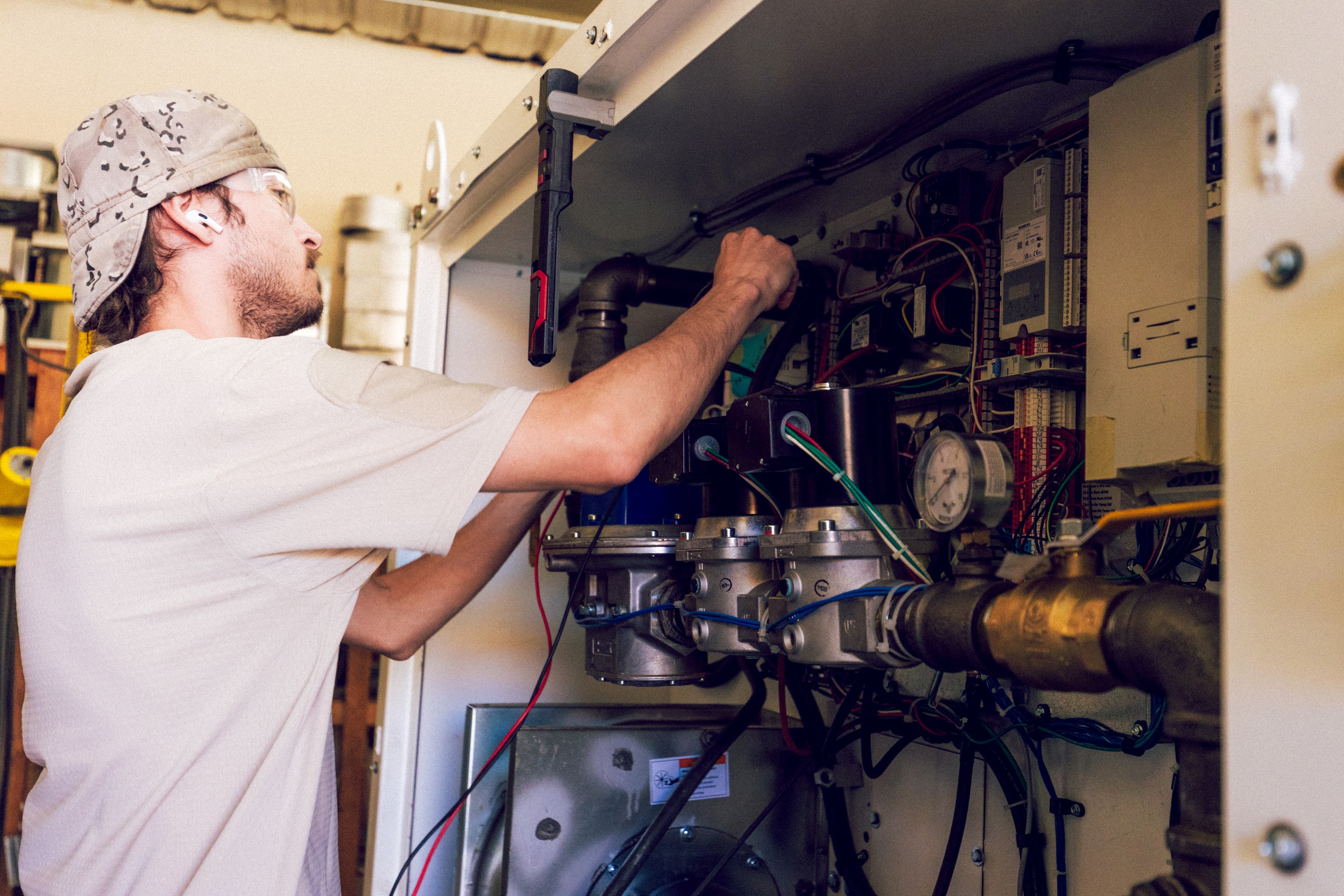
Check intake filters and housings, confirm the intake path is unobstructed, and inspect the air makeup unit's own filters, dampers, and controls. Where the unit is gas fired, burner service, combustion checks, and safety control verification belong with a qualified technician on a defined schedule. Where it is electric, check elements, contactors, and connections.
Confirm the booth's pressure balance periodically rather than assuming it. Changes elsewhere in the building, including new equipment or sealed openings, can shift a booth's balance without anyone touching the booth. See spray booth ventilation requirements for what the balance should be doing.
Lighting
Light output falls gradually as lenses accumulate overspray film, and operators compensate without noticing until finish quality slips.
Clean lenses on a schedule using methods appropriate to the fixture, replace failed lamps promptly rather than working around them, and confirm fixture seals and gaskets remain intact. Seal integrity matters for more than light output, because fixtures are sealed to keep the electrical equipment out of the classified area. A damaged seal is a safety issue rather than a cosmetic one. See LED booth lighting.
Doors, seals, and the booth envelope
The booth envelope is what makes the airflow design real. Leaks let unfiltered air in where it was never intended, which disturbs the airflow pattern and the pressure balance.
Inspect door seals and gaskets for wear, damage, and compression, check door hardware, hinges, latches, and closers, confirm doors close and seal fully, and inspect panel joints and penetrations for gaps. On outdoor booths this matters more, because the envelope is also the weather barrier and seals work harder.
Heating systems
Heating equipment carries its own maintenance requirements and, where gas fired, its own safety requirements.
Expect a qualified technician to handle burner inspection and service, combustion checks, safety control and interlock verification, heat exchanger inspection where applicable, and gas train inspection. Temperature sensing and control calibration should be confirmed too, because a drifting sensor produces cure cycles that are not what the coating manufacturer specified.
This is not general maintenance work. Combustion equipment should be serviced by someone qualified to do it. Spray booth heating systems covers the equipment itself.
Controls, interlocks, and monitoring
Safety systems fail silently, which is exactly why they need periodic proving rather than assumption.
Verify that airflow interlocks actually prevent spray operation without ventilation, that airflow and pressure monitoring reads accurately, that emergency stops function, that cycle timing and purge sequences operate as intended, and that alarms and indicators work. Document the verification, because it is evidence for both your own program and any inspection. Control panels covers what these systems typically include.
Cleaning and overspray control
Housekeeping is the maintenance task with the most direct safety consequence, because accumulated overspray residue is combustible.
Practical program:
- Booth walls and floor cleaned regularly, using protective coatings or films where appropriate so cleaning is stripping rather than scraping
- Never remove residue with tools or methods capable of producing sparks
- Grating and floor areas kept clear
- Plenum and accessible duct surfaces cleaned before accumulation becomes significant
- Solvent and rag storage managed to the applicable requirements, and waste handled correctly
- Booth interior kept clear of anything not required for the job
See OSHA and spray finishing operations for the workplace requirements that sit alongside this.
A workable inspection rhythm
Adjust to how hard the booth runs. A booth on two shifts needs a considerably tighter cycle than one used intermittently.
| Interval | Typical tasks |
|---|---|
| Daily | Visual check of booth interior and lighting, housekeeping, confirm airflow indication is normal, report anything unusual |
| Weekly | Check filter condition or differential pressure, clean lenses as needed, inspect doors and seals, check for overspray accumulation |
| Monthly | Inspect exhaust plenum, check belts and drives, verify airflow readings, review filter change records |
| Quarterly | Inspect accessible ducting, check fan wheel condition, inspect air makeup filters and dampers, test interlocks |
| Annually | Professional inspection: fans and bearings, heating and combustion service, controls and safety verification, full duct assessment, airflow verification against design |
Record what was done and what was found. A maintenance record is what turns a suspicion that something has changed into a diagnosis.
Signs professional service is needed
Call a technician rather than working around any of the following:
- Airflow measurably below design, or a booth that fails to clear as quickly as it used to
- Persistent finish contamination that filter changes do not resolve
- New noise, vibration, or heat from fans, motors, or drives
- Burner faults, ignition problems, inconsistent temperature, or any combustion related concern
- Interlocks, alarms, or airflow monitoring that do not behave as expected
- Visible overspray accumulation in ducting, or any evidence of residue beyond the plenum
- Any finding raised by an inspector or insurer
- Doors or panels that no longer seal, or visible damage to the envelope
Our service and preventive maintenance team handles this work, and technical support can help diagnose a problem before a visit is scheduled.
From California Pulse
Related equipment & services
Service & Preventive Maintenance
Scheduled service programs and field support.
ViewTechnical Support
Help diagnosing a problem before scheduling a visit.
ViewPaint Booth Accessories
Filters, coatings, and consumables for booth upkeep.
ViewControl Panels
Airflow monitoring and interlocks that make drift visible.
ViewAnswers
Frequently asked questions
How often should spray booth filters be changed?
What maintenance does a spray booth need?
How do I know if my booth's airflow has dropped?
Why does overspray build-up matter?
Can I do spray booth maintenance in-house?
How often should a spray booth be professionally inspected?
Keep Reading
Related resources
Spray Booth Ventilation Requirements
Intake and exhaust, airflow patterns, pressure balance, filtration, air makeup, and the ventilation mistakes worth avoiding.
Read GuideIndustrial Spray Booth Requirements
Ventilation, electrical, lighting, fire protection, filtration, exhaust, clearances, and permitting, and why requirements vary by project.
Read GuideSpray Booth Heating Systems
Application heat, cure cycles, gas versus electric, air makeup units, and how to work out which system your process needs.
Read GuideHow to Choose an Industrial Spray Booth
The complete buyer's guide. Twelve decisions in the order they should be made, from the part you finish to the manufacturer you choose.
Read Guide
Back to the Spray Booth & Finishing Systems Resources hub.
Put your booth on a maintenance schedule
Whether we built your booth or not, our service team can inspect it, verify airflow against design, and set up a preventive maintenance program.