Spray Booths Guide
Spray Booth Heating Systems
Heat is the difference between a booth that produces a consistent finish on a schedule and one whose output depends on the weather. Coatings are formulated to be applied and cured within temperature ranges, and a booth exhausting large volumes of air is constantly replacing conditioned air with whatever the outside is doing.
This guide explains why professional booths are heated, what the equipment options actually do, and how to work out which one your process needs.
Quick Answer
Spray booths are heated for two distinct reasons: to hold a stable application temperature so coatings flow, atomise, and level predictably, and to raise temperature for drying or curing so parts can be handled and released sooner. Because a booth exhausts large volumes of air, heating is normally delivered by an air makeup unit that replaces and conditions incoming air rather than by heating the room. The main choices are gas fired heat, which usually has lower running costs at industrial volumes and requires gas supply and venting, and electric heat, which is simpler to install and vent but needs substantial electrical service. The right choice depends on your coatings, whether you bake, your throughput, and the fuel and electrical capacity available at your building.
Why professional booths are heated
Three reasons come up repeatedly, and most shops have all three.
Stable application temperature. Coating viscosity, atomisation, flow, and levelling all shift with temperature. Spraying at whatever the ambient air happens to be means the process changes through the day and through the year, which shows up as inconsistent film build and finish defects.
Faster, more predictable drying and curing. Raising temperature after application shortens the time before a part can be handled, moved, or shipped, and releases the booth for the next job. On a booth that is a production bottleneck, cycle time is the entire argument.
Compensating for exhausted air. A booth moving large volumes of air is continuously drawing in replacement air. In winter, unheated replacement air is being pulled directly across freshly applied coating. Heating the makeup air is what stops the weather from setting your process conditions.
Application heat versus cure heat
These are different requirements and are often confused when specifying.
Application heat tempers incoming air to a comfortable, stable working temperature during spraying. The load is driven by how much air the booth moves and how cold the incoming air is.
Cure or bake heat raises the booth to a higher temperature after spraying and holds it for a set period. The system now has to reach a target and maintain it, usually with reduced airflow during the cycle, and it needs controls to manage the sequence.
The distinction matters because a system sized only to temper air will not deliver a bake cycle, and a system designed for baking is a larger specification with additional controls. Where a genuine cure process is involved, oven requirements including NFPA 86 may come into play. See understanding NFPA 86 and our powder coating ovens and booths for cure focused systems.
Air makeup units
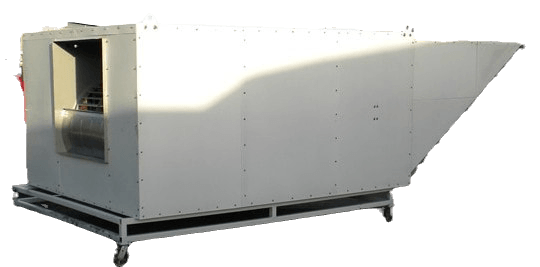
An air makeup unit is the piece of equipment most shops actually mean when they say booth heater. It draws outside air, filters it, heats it, and delivers it into the booth to replace what the exhaust removes.
That single unit is doing several jobs:
- Supplying the volume the exhaust needs so the booth achieves design velocity
- Filtering incoming air so contamination is not delivered onto wet coating
- Heating that air to application or cure temperature
- Contributing to the booth's pressure balance relative to the surrounding space
This is why heating and ventilation cannot be specified separately. The unit is sized against the booth's exhaust volume, which is set by the booth's cross section and required velocity. Change the booth size or the airflow and the heating equipment changes with it. Spray booth ventilation requirements covers the airflow side of that relationship, and gas heaters and air makeup units covers the equipment we build.
Gas fired heating
Gas heating is the common choice for industrial booths that move significant air volumes, largely because fuel cost per unit of heat is usually favourable at that scale.
Practical requirements:
- Gas supply to the unit, at adequate capacity and pressure
- Venting and combustion air arrangements appropriate to the burner type
- Combustion safety controls, and additional safety provisions where a cure process is involved
- Periodic burner service as part of the maintenance program
Direct fired and indirect fired arrangements differ in how combustion products are handled and therefore in efficiency and suitability, and the appropriate arrangement depends on the process and coatings involved. That is a specification conversation rather than a general rule, and it is one to have alongside the coating manufacturer's requirements. Our gas heaters and air makeup units page covers the equipment.
Electric heating
Electric heat removes gas piping, combustion venting, and burner maintenance from the project, which simplifies installation and is sometimes the only option where gas is unavailable or where site conditions make gas impractical.
The trade is electrical service. Heating a substantial airflow electrically requires considerable capacity, and where the existing service cannot support it, a service upgrade may cost more than the heating equipment. Energy cost per unit of heat is also typically higher than gas, so running cost over the booth's life deserves attention rather than a purchase price comparison.
Electric heat suits smaller booths, lower airflow applications, sites without gas, and installations where simplicity of installation and permitting outweighs running cost.
Gas or electric
| Factor | Gas fired | Electric |
|---|---|---|
| Typical running cost at volume | Usually lower | Usually higher |
| Installation scope | Gas piping, venting, combustion air | Electrical capacity and distribution |
| Building requirement | Gas service at adequate capacity | Substantial electrical service |
| Maintenance | Includes burner and combustion service | Generally simpler |
| Suits | Larger booths, high airflow, frequent baking | Smaller booths, lower airflow, sites without gas |
The decision usually comes down to what your building can actually supply. Confirm both your gas availability and your spare electrical capacity before specifying, because the answer often settles the question by itself.
Temperature control and cycle management
Heating equipment is only as good as the control over it. A production booth typically needs to hold a stable temperature during spray, transition to a cure cycle, hold the target for a set period, and return to a safe idle state.
That is a controls specification: temperature sensing and control, spray and cure mode management, timing, interlocks with airflow so heat cannot run without ventilation, and appropriate safety provisions. Control panels covers what those systems include, and integrating them at design time is considerably easier than retrofitting them.
Where the process requires humidity control as well as temperature, that is an additional specification. See temperature and humidity control.
Airflow, energy, and running cost
In a heated booth, airflow is energy. Every cubic foot exhausted is conditioned air leaving the building, so the two largest influences on heating cost are how much air the booth moves and how long it moves it.
Levers that make a measurable difference:
- Right sized airflow. Adequate for the booth type and process, not generous for its own sake.
- Variable frequency drives. Reducing airflow during cure and idle rather than running full spray volume continuously.
- Cycle control. Automating spray, flash, and cure so the system is not simply left running.
- Filter maintenance. Loaded filters make fans work harder and disturb the airflow the heating was sized around. See the maintenance guide.
- Envelope condition. Seals, doors, and panel integrity, which matter more on outdoor booths.
These are design decisions with permanent operating consequences, which is why heating belongs in the specification conversation rather than being added afterwards. Industrial spray booth cost covers how heating lands in the project budget.
Working out what your process needs
Answer these before specifying heating equipment:
- What are you spraying, and what does the coating manufacturer specify for application temperature and cure schedule?
- Do you need to bake, or only to control application temperature? This changes the specification substantially.
- How much air does the booth move? Heating follows exhaust volume.
- What is your climate? Heating load is calculated against local design conditions, and an outdoor booth is sized against outdoor ambient.
- What is available at the building? Gas service and capacity, and spare electrical capacity.
- What is your throughput? Cycle time requirements determine whether cure heat pays for itself.
- What are you finishing next? Heating capacity is difficult to enlarge later.
With those answers a system can be engineered rather than estimated. If the process is drying rather than baking, convection drying systems may be the better fit, and industrial heating equipment covers the full range.
From California Pulse
Related equipment & services
Gas Heaters & Air Makeup Units
Gas fired heating and makeup air built for booth airflow.
ViewElectric Heaters
Electric heating where gas is unavailable or impractical.
ViewConvection Drying Systems
Drying and curing where the process needs more than tempered air.
ViewTemperature & Humidity Control
Controlled conditions for sensitive coatings and processes.
ViewAnswers
Frequently asked questions
Does a spray booth need to be heated?
What is an air makeup unit and do I need one?
Is gas or electric heat better for a spray booth?
What is the difference between a booth heater and a bake cycle?
How much does it cost to run a heated spray booth?
Can heating be added to an existing spray booth?
Keep Reading
Related resources
Spray Booth Ventilation Requirements
Intake and exhaust, airflow patterns, pressure balance, filtration, air makeup, and the ventilation mistakes worth avoiding.
Read GuideHow to Choose an Industrial Spray Booth
The complete buyer's guide. Twelve decisions in the order they should be made, from the part you finish to the manufacturer you choose.
Read GuideIndustrial Spray Booth Cost
The variables that move spray booth pricing, why a single published price is misleading, and how to build a realistic project budget.
Read GuideSpray Booth Maintenance Guide
Filters, fans, exhaust, seals, lighting, controls, overspray, inspection rhythm, and the signs that service is overdue.
Read Guide
Back to the Spray Booth & Finishing Systems Resources hub.
Get the heating sized against your airflow
Tell us your booth size, coatings, cure requirements, climate, and available gas or electrical capacity, and we will engineer the heating with the ventilation.