Spray Booths Guide
Indoor vs Outdoor Spray Booths
The choice between putting a booth inside the building and putting one outside it is usually forced by space, but it deserves more thought than that. Placement affects installation cost, weather exposure, permitting, maintenance access, how the booth fits your workflow, and how easily you can expand later.
This guide sets the two side by side. California Pulse manufactures custom outdoor spray booths as well as indoor systems, and there is genuinely no universal answer. The right choice depends on your building, your site, your climate, and the work.
Quick Answer
An indoor spray booth sits inside an existing building, using its structure, power, and climate, and is the usual choice where floor space, clear height, and exhaust routing are available. An outdoor spray booth is a self-supporting weather-rated structure installed on a pad or foundation outside, and it is generally the better route when the building has no usable space, when adding a booth would consume floor area needed for production, or when a building expansion would cost more than the booth. Outdoor units avoid a building expansion and free interior space, but they require a foundation, weather-rated construction, exterior utility runs, and site access. Indoor units use what you already have but consume floor space and must work with the building's air balance, fire protection, and exhaust routing.
The short comparison
| Consideration | Indoor booth | Outdoor booth |
|---|---|---|
| Space | Consumes production floor area | Frees interior space, uses site area |
| Building work | Must fit existing height, columns, and structure | Avoids building expansion entirely |
| Foundation | Usually sits on existing floor | Requires a pad or engineered foundation |
| Weather | Protected by the building | Weather-rated construction required |
| Utilities | Shorter runs inside the building | Exterior electrical and gas runs |
| Climate control | Benefits from building conditioning | Heating and conditioning handled by the booth |
| Exhaust | Ducting through wall or roof | Discharges directly outdoors |
| Maintenance access | Indoor, in comfortable conditions | Outdoors, in whatever the weather is |
| Expansion later | Limited by the building | Limited by the site, usually more flexible |
Neither column is universally better. Which considerations bind hardest is what decides it.
Space and building limitations
Space is the most common reason the question is asked at all.
An indoor booth has to fit the building it goes in: usable floor area after aisles and other equipment, clear height under joists, ducting, and sprinkler lines, and column positions that often dictate where a booth can physically sit. Many shops discover that the space that looks available is not once access and service clearance are drawn in. Industrial spray booth sizes covers the measuring exercise.
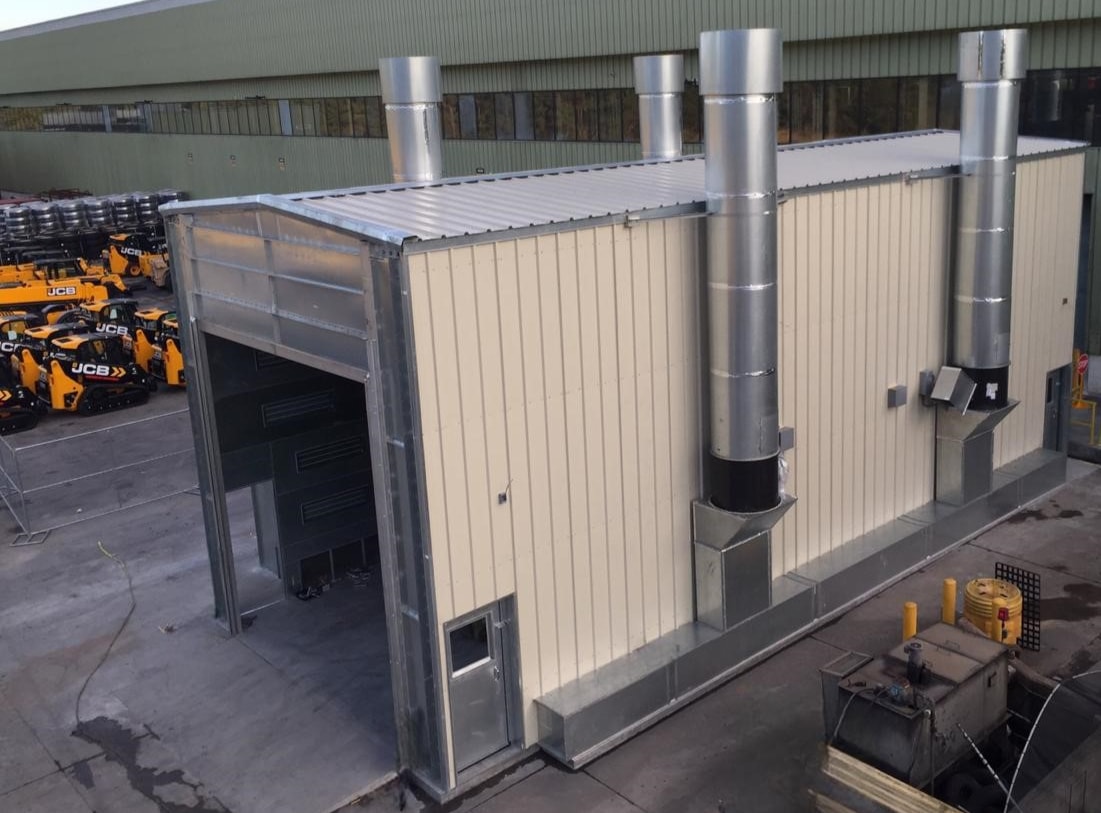
An outdoor booth changes the constraint from building to site. Instead of asking what fits inside, you ask whether there is a suitable location on the property with access, utilities within reach, and a legal discharge point. For shops that would otherwise need a building expansion, that is usually the less expensive path to capacity, and it returns interior floor space to production.
Weather and environmental exposure
An indoor booth is protected by the building, and the building's own conditioning helps stabilise the environment around it.
An outdoor booth handles conditions itself. That means weather-rated construction, sealed panels and doors, and heating sized for outside ambient rather than shop ambient. It is entirely workable, and outdoor booths run in demanding climates, but it should be specified deliberately rather than assumed.
Practical points on outdoor installations:
- Heating load is calculated from outdoor design conditions, not indoor
- Seals, doors, and penetrations do more work and matter more
- Wind and, in some regions, snow loading are structural inputs
- Solar gain and surface temperature can influence coating behaviour
- Operator comfort during entry and exit is a real workflow consideration
Where the process needs tight environmental control, temperature and humidity control applies to both placements, but it is more central to an outdoor specification.
Structural engineering and foundations
An indoor booth generally sits on an existing slab and is supported by the building. Confirm the floor can carry the booth and the parts, especially where a pit is planned or parts are heavy, and confirm that any equipment mounted overhead has adequate structural support.
An outdoor booth is a self-supporting structure and needs a foundation or pad engineered for it, along with anchorage and structural design that accounts for local wind and snow loading. That engineering is part of the project rather than an afterthought, and it is one of the reasons an outdoor booth needs a properly scoped site preparation budget. Industrial spray booth cost breaks out where that work lands.
Installation
Indoor installation works within an operating facility, which usually means coordination around production, careful rigging through existing openings, ducting runs to an exterior wall or roof, and tie-ins to existing electrical and fire protection systems. Access can be the hardest part, since the booth has to get into the space it will occupy.
Outdoor installation trades that for site work: foundation, anchorage, exterior electrical and gas runs, and site access for delivery and equipment. It generally disrupts production less, because the work happens outside the building envelope, but it introduces weather into the schedule.
Either way, installation and commissioning covers how the work is sequenced and verified.
Maintenance and accessibility
Maintenance is where placement quietly shows up for years afterwards.
An indoor booth is serviced indoors. Filter changes, fan and drive service, and cleaning happen in a controlled environment, which tends to mean maintenance actually gets done on schedule.
An outdoor booth is serviced outdoors, in the weather, which is a real factor in whether routine tasks slip. It is worth specifying good service access deliberately: filter access at a workable height, safe access to fans and any roof-mounted equipment, and lighting for service outside daylight hours. The tasks themselves are the same either way, and the spray booth maintenance guide covers them, but the conditions differ.
Permitting and code
Both placements are permitted and inspected, and both are subject to the same core standards for spray application. The emphasis differs.
An indoor booth raises questions about separation from other operations and combustible construction, integration with the building's fire protection, exhaust routing through the building envelope, and the effect of booth exhaust on the building's overall air balance.
An outdoor booth raises questions about site placement and setbacks, discharge location relative to property lines, openings, and neighbouring buildings, structural design and anchorage, and exterior utility routing. Some jurisdictions also apply zoning or site plan review to an exterior structure, which is a separate approval track from the building and fire permits.
Industrial spray booth requirements and codes and compliance cover the common ground, and your authority having jurisdiction decides how it applies locally.
Cost considerations
Neither placement is reliably cheaper. They spend money in different places.
An indoor booth avoids foundation and weather-rated construction and usually has shorter utility runs, but it consumes floor space with real value, requires ducting through the building envelope, and may require modifications to fire protection or air handling. If it forces a building expansion, that expansion dominates the budget.
An outdoor booth adds a foundation, weather-rated construction, exterior utility runs, and site work, but it avoids a building expansion and returns interior space to production. Where a shop is genuinely out of room, the comparison is usually outdoor booth against new construction, and the booth tends to win that comparison comfortably.
Run both as complete project budgets, including site work and soft costs, rather than comparing equipment quotes alone.
Which one suits your project
An indoor booth tends to be right when the building has genuinely usable space with adequate clear height, exhaust can reach the outside without difficulty, parts already move within the building, and the climate or process argues for keeping work inside.
An outdoor booth tends to be right when the building has no usable space, when the alternative is a building expansion, when interior floor area is more valuable used for production, when parts are large or awkward and already arrive outside, or when you want capacity without disrupting the existing operation.
Some sites do both, keeping smaller precision work inside and moving large equipment outdoors. If you are weighing it, how to choose an industrial spray booth puts placement in sequence with the other decisions, and our outdoor spray booth page shows what we build for exterior installations.
From California Pulse
Related equipment & services
Outdoor Spray Booths
Custom weather-rated booths built for exterior installation.
ViewIndustrial Spray Booths
The full range of indoor and outdoor booth types.
ViewContainer Spray Booths
Portable, self-contained booths for constrained sites.
ViewInstallation & Commissioning
Site work, installation, and verification for either placement.
ViewAnswers
Frequently asked questions
Still have a question about your project? Send it with your details and our engineers will answer it in writing.
Is an outdoor spray booth as good as an indoor one?
Do outdoor spray booths need a foundation?
Is an outdoor booth cheaper than an indoor booth?
How do outdoor spray booths handle cold or wet weather?
Does an outdoor spray booth need different permits?
Can I move an outdoor booth later?
Keep Reading
Related resources
Industrial Spray Booth Sizes
Sizing starts with the part, not a catalogue number. Clearances, door openings, handling, facility limits, and future capacity.
Read GuideIndustrial Spray Booth Cost
The variables that move spray booth pricing, why a single published price is misleading, and how to build a realistic project budget.
Read GuideHow to Choose an Industrial Spray Booth
The complete buyer's guide. Twelve decisions in the order they should be made, from the part you finish to the manufacturer you choose.
Read GuideIndustrial Spray Booth Requirements
Ventilation, electrical, lighting, fire protection, filtration, exhaust, clearances, and permitting, and why requirements vary by project.
Read Guide
Back to the Spray Booth & Finishing Systems Resources hub.
Not sure whether to go inside or outside
Send us your building dimensions and a photo of the site. We will tell you honestly which placement makes more sense for the work you do.