Powder Coating Guide
Conveyorized vs Batch Powder Coating Systems
Batch or conveyorized is the layout decision that shapes a powder shop for a decade. It determines the building you need, the labor model you run, the capital you spend, and the kind of work you can profitably accept.
It is usually framed as a volume question, and volume is only half of it. Part mix matters just as much, and a shop with high volume across many different parts can easily be better served by batch than by a line. This guide sets the two models side by side so the decision is made on the right variables.
Quick Answer
A batch powder system loads parts onto carts or racks, sprays them in a booth, and cures them in a batch oven, one load at a time. A conveyorized system carries parts continuously on an overhead conveyor through wash, dry off, booth, and cure oven. Batch uses less capital and floor space and handles a wide part mix, but labor per part is higher and throughput is limited by cart and oven cycles. Conveyorized systems drop labor per part sharply and give predictable output, at much higher capital and space requirements. The crossover point is driven by part mix as much as volume: high volume of one part favors a line, while moderate volume across fifty different parts often still favors batch.
The two models
Batch. Parts are loaded onto carts, racks, or hangers, moved to the booth, coated, then moved to a batch oven and cured as a load. Each step is a discrete operation with a person doing the moving. The equipment is a booth, an oven, and material handling that can be as simple as carts on a floor.
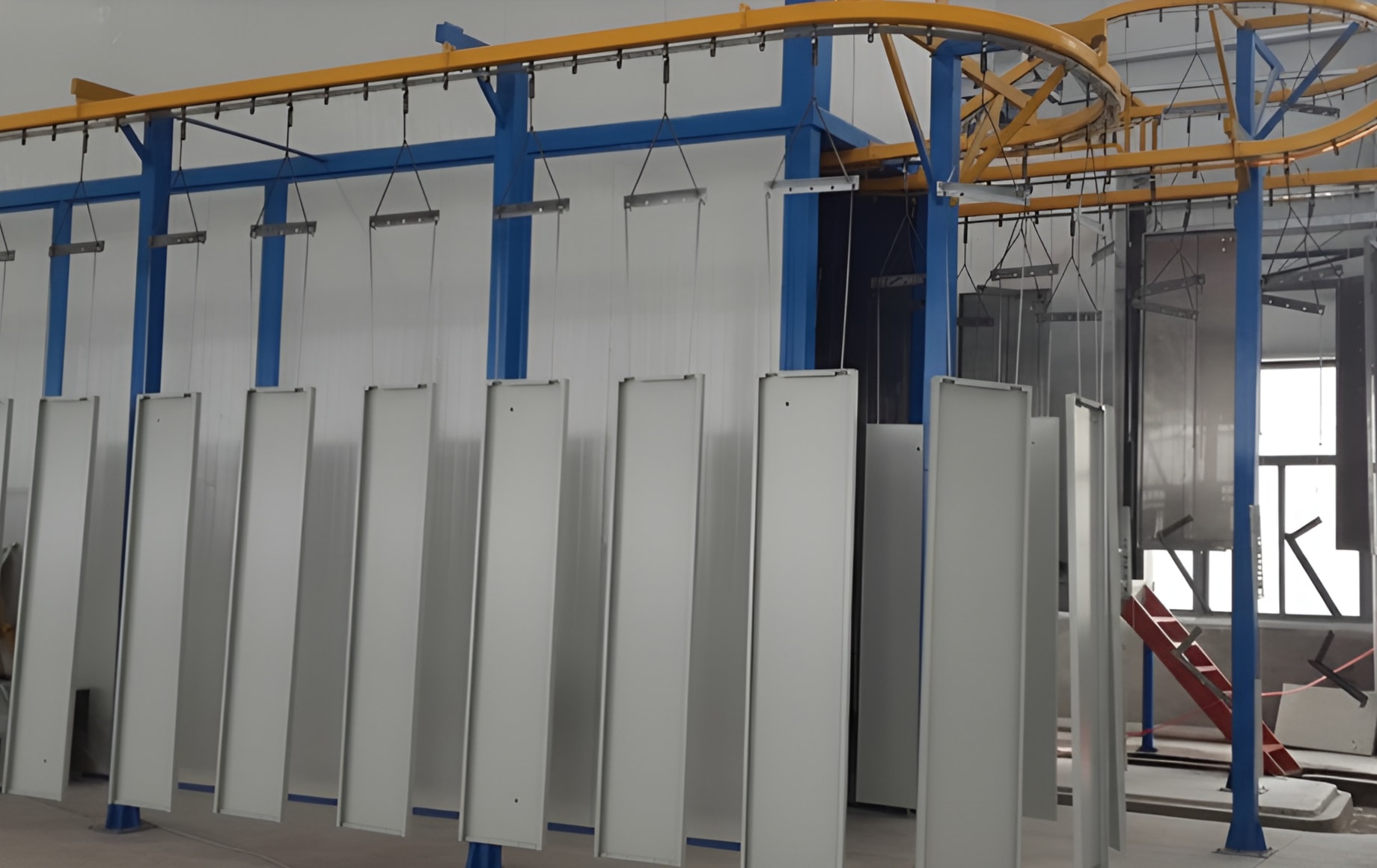
Conveyorized. Parts hang from an overhead conveyor that carries them continuously through the process: wash and pretreatment, dry off, the powder booth, and the cure oven, all inline. The conveyor sets the pace, and the equipment is sized around line speed rather than around loads.
The difference is not just scale. They are different operating models. Batch is flexible and labor intensive. A line is fast and rigid. Neither is an upgrade of the other in every dimension, which is why the decision deserves real analysis rather than a default.
Batch systems: strengths and limits
Batch is where most powder shops start, and where a great many profitably stay.
Strengths. Lower capital, smaller building requirement, and the ability to handle almost any part that fits the envelope. A batch shop can take a one off weldment on Monday and a run of brackets on Tuesday without changing anything. Cure schedules can be varied load by load to suit different powders. Downtime in one area does not stop everything.
Limits. Labor per part is high, because a person moves every cart. Throughput is capped by the oven cycle and by how quickly loads can be turned around. Output is less predictable because it depends on how the day is organized. And as volume rises, the shop hits a ceiling where adding people stops helping, because the oven is the constraint.
The equipment side is straightforward: a booth sized for the part, an oven sized for the load and the cycle, and carts. Sizing both correctly is covered in powder coating booth design and powder coating oven sizing.
Conveyorized systems: strengths and limits
A line changes the economics of high volume work.
Strengths. Labor per part drops sharply, since parts move themselves and operators stay at their stations. Output becomes predictable, which makes quoting and scheduling much easier. Quality becomes more consistent because every part sees the same process at the same speed. Pretreatment can be integrated inline rather than run as a separate operation.
Limits. Capital is much higher and so is the building requirement, since wash, dry off, booth, and oven all have to sit in line with the conveyor path. Flexibility falls: the line runs at one speed with one cure dwell, so parts with very different masses or cure schedules do not sit comfortably together. Hanging and fixturing become an engineering discipline of their own. And a stoppage anywhere stops the whole line.
The material handling side is its own project, covered in conveyor and crane systems.
Part mix decides as much as volume
This is the point most often missed.
A conveyor line is at its best when many parts share a similar mass, a similar cure schedule, and similar hanging requirements, because the line has one speed and one dwell for everything on it. High volume of one part, or of a family of similar parts, is the ideal case.
Moderate volume spread across fifty different parts is a different problem. Those parts want different dwell times and different fixtures, and running them on a line means either compromising the schedule or constantly changing the setup, which erodes the very advantage the line was bought for.
So ask two questions rather than one. How much do you run, and how alike is it? High volume plus high similarity points to a line. High volume plus high variety often still points to batch, or to a hybrid.
Floor space, building, and labor
| Batch | Conveyorized | |
|---|---|---|
| Capital | Lower | Substantially higher |
| Floor space | Compact, flexible arrangement | Large, and the layout is fixed by the conveyor path |
| Building | Often fits an existing shop | Frequently drives a building decision |
| Labor per part | Higher, operators move every load | Lower, parts move themselves |
| Output predictability | Depends on how the day runs | High, set by line speed |
| Part mix flexibility | High | Limited to what the line's speed and dwell suit |
| Failure impact | Localized | A stoppage halts the line |
The building row deserves attention. A line does not just need more square feet, it needs them in a particular shape, with the height for the conveyor and the run length for wash, dry off, booth, and oven in sequence. That is why the layout question often becomes a real estate question.
Changeover and color change
Both models change color, but the cost of doing it is different.
On a batch system, a color change is a booth cleandown between loads. It is disruptive to the shop's rhythm but it does not idle a whole line, and a batch shop can sequence its work to group colors together and keep changes to a minimum.
On a conveyorized system, a color change stops production across the entire line. That is why lines are often specified around a small palette, or with faster color change arrangements such as a cyclone based collection or a quick change module, and why line shops put real effort into scheduling colors in blocks.
Either way, the collection and reclaim arrangement is the biggest single factor in changeover time, which is covered in recovery versus non-recovery systems and powder booth filtration.
The growth path from batch to line
Most shops do not choose once. They start batch and grow, and there is a sensible way to do that.
The usual sequence is: batch booth and batch oven; then a second booth or a larger oven as volume rises; then a monorail or simple conveyor to move parts between stations while still curing in batch; then a full inline system when the volume and the part mix genuinely justify it.
The decision worth making early is not which system to buy, but whether the building and the utilities leave room for the next step. Ceiling height, floor area, gas capacity, and electrical service are the constraints that determine whether growth is an expansion or a relocation. That is worth confirming while the first booth is being specified, not after.
Hybrid arrangements
Between the two models there is a lot of useful ground.
A monorail feeding a batch oven gives you continuous handling through the booth while retaining the flexibility of batch cure. A conveyor through booth and oven with manual load and unload stations gives most of the labor saving without the full inline wash system. Two booths sharing one oven can lift throughput without the capital of a complete line.
These arrangements are common in shops with a genuine split in their work: a core of repeat volume plus a stream of varied jobs. If that describes your order book, describe it to your supplier that way. Designing for the average of two very different workloads produces a system that serves neither.
How to decide
Gather these before you compare quotes:
- Parts per shift or per year, and the realistic growth curve
- How many distinct parts, and how similar they are in mass and cure schedule
- The largest and heaviest part, with fixturing
- Number of colors and how often they change
- Labor available, and what labor costs in your area
- Building: floor area, shape, ceiling height, and whether expansion is possible
- Available gas and electrical service
- How much of the work is repeat versus one off
If volume is high and the mix is narrow, model a line. If volume is moderate or the mix is wide, model batch and put the capital difference into a better booth and oven. If the answers point both ways, model a hybrid before compromising on either. Custom design covers how we work through that with a shop.
From California Pulse
Related equipment & services
Answers
Frequently asked questions
Still have a question about your project? Send it with your details and our engineers will answer it in writing.
What is the difference between batch and conveyorized powder coating systems?
At what volume does a conveyorized powder system make sense?
Which system uses less labor?
How does color change differ between batch and conveyorized systems?
Can I start with a batch system and move to a conveyor later?
How much floor space does a conveyorized powder line need?
Keep Reading
Related resources
Powder Coating Oven Sizing
Working envelope, heat load, and cycle time, and why metal temperature rather than air temperature decides whether a part is really cured.
Read GuidePowder Coating Booth Design
Open face versus enclosed, airflow and containment, interior surfaces, grounding, and how color change strategy shapes the booth before it is built.
Read GuideRecovery vs Non-Recovery
What reclaim really saves, what it costs in color change time and labor, and how part mix decides between recovery and spray to waste.
Read GuidePowder Coating Compliance Guide
NFPA 33 and 86, combustible dust, electrical, OSHA, ETL listing, and air district review, in the order they come up on a real project.
Read Guide
Back to the Spray Booth & Finishing Systems Resources hub.
Model both before you commit
Send us your part mix, volumes, and building. We will lay out a batch arrangement and an inline arrangement against the same work so you can see what each one really costs.