
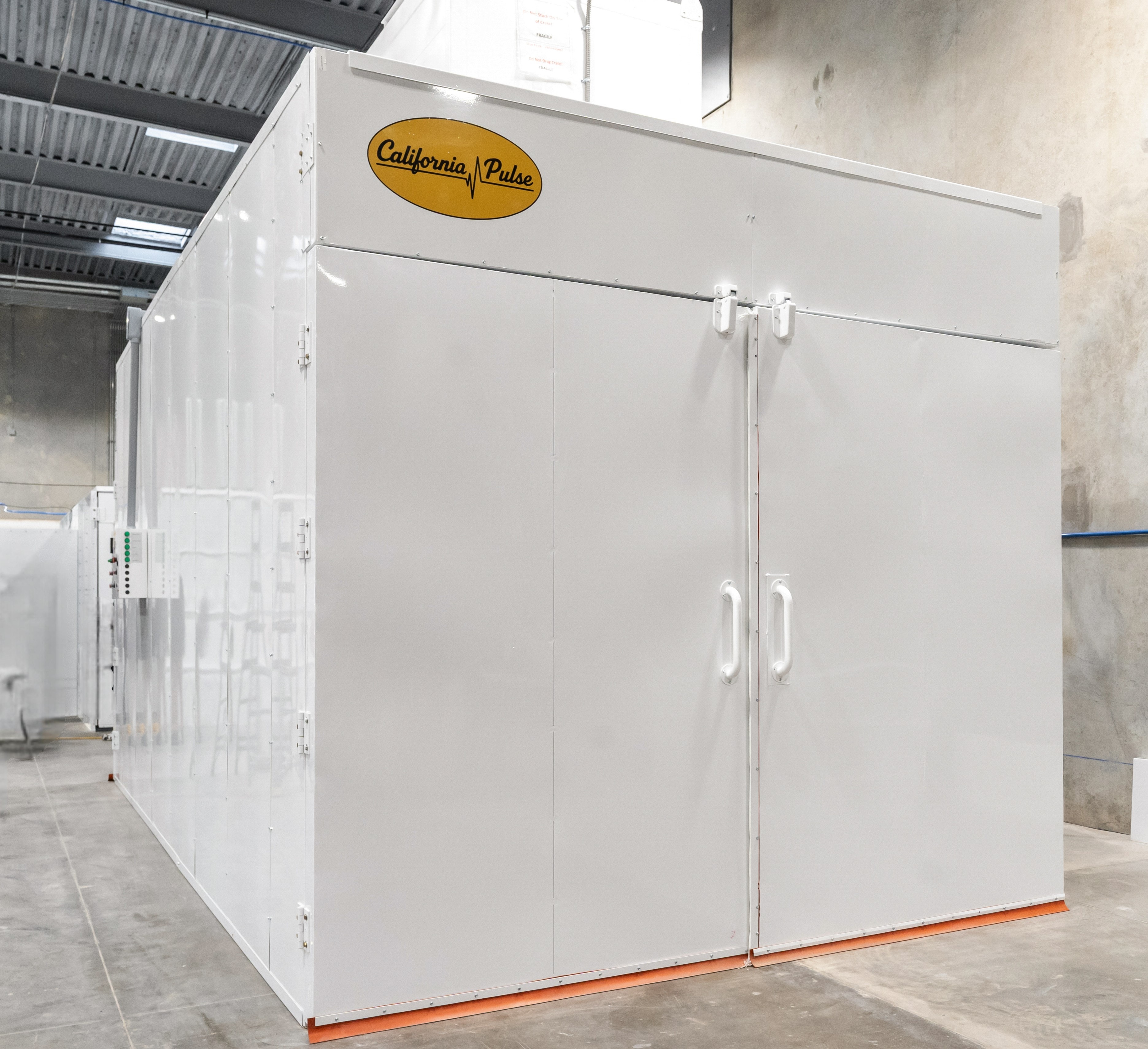
Powder Coating Guide
Powder Coating Oven Sizing: Getting the Working Envelope Right
The cure oven is where powder becomes a coating. Everything before it is preparation, and everything after it is inspection. It is also the piece of equipment most often sized by the wrong measure, because the obvious question, will the part fit, is not the question that decides whether the oven works.
An oven has to bring the part itself to cure temperature and hold it there for the schedule the powder requires, then be ready to do it again for the next load. This guide covers how that requirement turns into an envelope, a heat load, and a cycle time you can plan production around.
Quick Answer
Powder coating oven sizing starts with the working envelope: the largest part plus its fixture or cart, plus clearance on all sides for air circulation, since dead spots produce uneven cure. Then it is sized on heat load rather than volume alone, because the oven has to raise the mass of the part, the fixture, and the cart to cure temperature, not just heat the air. Most thermoset powders cure in roughly 10 to 20 minutes at 350°F to 400°F, but the manufacturer's technical data sheet is the authority and the schedule refers to metal temperature, not oven air temperature. Heavy parts take significant time to reach temperature, so cycle time is load plus ramp plus dwell plus unload, and recovery after door openings has to be part of the calculation.
Metal temperature, not air temperature
This is the single most important idea in oven sizing, and the one that causes the most trouble when it is missed.
The cure schedule on a powder technical data sheet refers to the temperature of the metal, held for a period. It does not refer to the temperature of the air in the oven. Most thermoset powders cure in roughly 10 to 20 minutes at 350°F to 400°F, but the data sheet for your specific powder is the authority, and schedules vary widely between chemistries.
A heavy weldment placed into an oven already at temperature does not reach that temperature immediately. It absorbs heat until its mass comes up, and only then does the cure clock start. Undercured powder is the failure mode that hurts most, because it looks finished. The part comes out glossy and uniform, then fails adhesion and chemical resistance in service or in test.
The practical consequence is that oven sizing is a heat problem before it is a space problem.
The working envelope
The working envelope is not the internal dimension of the oven. It is the space in which a part can actually be cured correctly, and it is smaller.
Build it up in this order:
- The largest part you intend to run, in all three dimensions
- The fixture, rack, or cart it sits on, which is frequently larger than the part
- Clearance on all sides for air to circulate around the part, since a part crowded against a wall or another part cures unevenly
- Clearance from the supply and return openings so the air pattern is not short circuited
- Door opening dimensions that clear the loaded cart with handling room
Then confirm the same part passes through the booth envelope. Booth and oven have to be specified together, which is covered in powder coating booth design. It is not unusual for a shop to buy a booth that accepts a part and an oven that does not, and there is no cheap fix for that afterwards.
Heat load: what the oven actually has to heat
The burner or element is sized for the total heat load, which has several components that shops routinely leave out.
| Load | What it is | Often forgotten |
|---|---|---|
| Product | The mass of the parts themselves | No |
| Fixture and cart | Racks, hangers, and carts that go in with the parts | Frequently |
| Oven structure | Bringing the oven itself up from cold | Sometimes |
| Air changes | Ventilation air required for the process, heated continuously | Frequently |
| Losses | Through walls, roof, floor, and door seals | Sometimes |
| Door openings | Heat lost every time the oven is opened and the recovery to bring it back | Almost always |
The mass of carts and fixtures is the one that surprises people most. A heavy steel cart can rival the parts it carries, and it absorbs heat on every cycle. If your fixturing is heavy, say so when the oven is being sized, because it changes the burner selection.
Cycle time and throughput
Throughput is what you actually buy, and it is not the cure time on the data sheet.
A batch cycle is: load, close, ramp the part to metal temperature, hold for the cure dwell, open, unload, and recover. On top of that sits whatever the shop needs for staging and handling. The oven's contribution to capacity is that whole cycle, repeated.
Two levers move it. The first is ramp: heavier parts and heavier fixtures take longer to reach temperature, and more burner capacity shortens that. The second is recovery: every door opening dumps heat, and how quickly the oven comes back determines whether the next cycle starts on time or waits.
If your production plan depends on a specific number of loads per shift, work that number backwards through the cycle during design. An oven sized to hold the part but not to hit the cycle is a bottleneck that gets discovered in month two.
Batch oven or conveyorized oven
The two are sized on different measures, which is why the choice has to be made before sizing starts.
A batch oven is sized on the envelope and the cycle: what fits, and how long a load takes end to end. It takes carts or racks through doors, handles a wide part mix, and suits moderate volume. Capital and floor space are lower, and flexibility is high.
A conveyorized oven is sized on line speed and dwell: the oven has to be long enough that a part travels through it for the full cure time at the conveyor's speed. That makes oven length a function of throughput rather than of part size, and it is why conveyor ovens get long quickly when cure times are long.
Which model suits your shop is really a question about part mix and volume, and it is worked through in conveyorized versus batch powder systems. Get that decision settled first; the oven follows from it.
Temperature uniformity and air pattern
A large oven with poor air distribution is worse than a small one with good distribution, because it produces parts that look cured and are not.
Uniformity comes from the supply and return arrangement, the recirculation rate, and how the load is placed inside the envelope. Dead spots form where air cannot circulate: behind a crowded rack, in the shadow of a heavy fixture, in corners the pattern does not reach. Parts sitting in those areas run cooler than the oven's control point suggests.
Two habits protect you. Load the oven the way it was designed to be loaded, with the clearances that were assumed when it was sized. And verify with a part mounted logger when you introduce a new part, a new fixture, or a new loading pattern, rather than assuming the previous survey still applies.
Gas or electric
Both are used for powder cure, and the choice is usually made by what the building can supply rather than by preference.
Gas heating brings gas piping, venting, and combustion safety controls, and its running cost profile depends on local fuel prices. Electric heating avoids combustion entirely and simplifies some of the installation, but it requires a substantially larger electrical service, and a service upgrade can rival the cost of the oven itself.
Confirm what you actually have available, in both gas supply and electrical capacity, before the oven is specified. This is the same constraint that governs booth heating, covered in spray booth heating systems, and it is the most common source of late surprises on a finishing project. Gas heaters and electric heaters cover the equipment side.
Controls, safety, and NFPA 86
Cure ovens fall within NFPA 86, the standard for ovens and furnaces, and that has real consequences for how the oven is built and controlled.
In practice it shows up as safety interlocks, purge cycles before the heat source is allowed to fire, excess temperature limit controls independent of the process controller, and the documentation that supports plan review. These are not optional features that can be traded away for a lower price; they are the requirements that let the oven be approved and operated.
Controls beyond the safety minimum are worth considering on their merits: recipe control for multiple powders, recorded temperature data for customers who require proof of cure, and staged ramp control for heavy loads. Control panels covers that scope, and NFPA 86 explains the standard's role. The compliance picture for a whole powder installation is in the powder coating compliance guide.
What your building has to accommodate
Ovens are constrained by buildings more often than by budgets. Confirm these before design gets far:
- Ceiling height, including clearance above the oven and any roof mounted equipment
- Floor area, including the space in front of the doors for carts to be loaded and turned
- Floor loading, particularly for heavy carts and loaded parts
- Gas supply capacity, or available electrical service if electric
- Ventilation routing and any roof penetrations required
- Fire protection provisions and how the oven ties into them
- The route from the booth to the oven, and how parts travel it
That last one is regularly overlooked. A booth and an oven that are correct individually but sit on opposite sides of an aisle create a handling problem that costs labor on every part. Installation and commissioning covers how the physical work is scoped.
Common sizing mistakes
- Sizing on part dimensions alone. The fixture, the cart, and the circulation clearance all take space the part does not.
- Ignoring fixture mass. Heavy carts absorb heat every cycle and lengthen ramp time.
- Confusing air temperature with metal temperature. The cure schedule refers to the part, and heavy sections lag well behind the air.
- Forgetting recovery after door openings. On a busy batch shop, recovery time is a real part of the cycle.
- Sizing an oven to today's largest part. Envelope is the hardest thing to change later; a modest allowance now is cheap.
- Specifying the oven separately from the booth. They must accept the same part on the same fixture.
- Leaving the electrical or gas supply until last. It can be the item that determines the whole approach.
What we need to size an oven
- The largest part, with dimensions and weight
- The fixture, rack, or cart, with its weight
- The powder or powders you run, and the cure schedules from their data sheets
- How many parts per load and how many loads per shift you need
- Batch or conveyorized, and if conveyorized the intended line speed
- Available gas supply and electrical service
- Building constraints: ceiling height, floor area, floor loading, and roof access
- Any customer requirement for recorded cure data
With those, the envelope, the heat load, and the cycle can be calculated rather than estimated. Powder coating ovens and booths covers the equipment, and custom design covers how we engineer to a specific part and building.
From California Pulse
Related equipment & services
Answers
Frequently asked questions
Still have a question about your project? Send it with your details and our engineers will answer it in writing.
How do I size a powder coating oven?
What temperature and time does powder coating need to cure?
Why does my powder look cured but fail testing?
Should I choose a batch oven or a conveyorized oven?
Does the cart or fixture affect oven sizing?
Should a powder cure oven be gas or electric?
Keep Reading
Related resources
Conveyorized vs Batch Systems
How the two models differ in capital, space, labor, and flexibility, and why part mix decides the crossover point as much as volume does.
Read GuidePowder Coating Booth Design
Open face versus enclosed, airflow and containment, interior surfaces, grounding, and how color change strategy shapes the booth before it is built.
Read GuidePowder Coating Compliance Guide
NFPA 33 and 86, combustible dust, electrical, OSHA, ETL listing, and air district review, in the order they come up on a real project.
Read GuidePowder Booth Filtration
The collection train from booth to final filter, how cartridges and pulse cleaning work, and the pressure drop and maintenance that decide performance.
Read Guide
Back to the Spray Booth & Finishing Systems Resources hub.
Size the oven around your heaviest part
Send us your largest part and fixture with weights, your powder data sheets, and the loads per shift you need. We will calculate the envelope, the heat load, and the cycle, then quote it.