Drying Waterborne Paints: The Science and Technology Behind Focused Directional Turbulent Systems
November 2, 2025
Waterborne paints boast lower environmental impact through lower VOC emission. Waterborne paint uses water as the primary solvent rather than volatile organic solvents (VOCs). This is the biggest reason environmental rules and regulations are pushing for the use of waterborne pai
Quick Answer
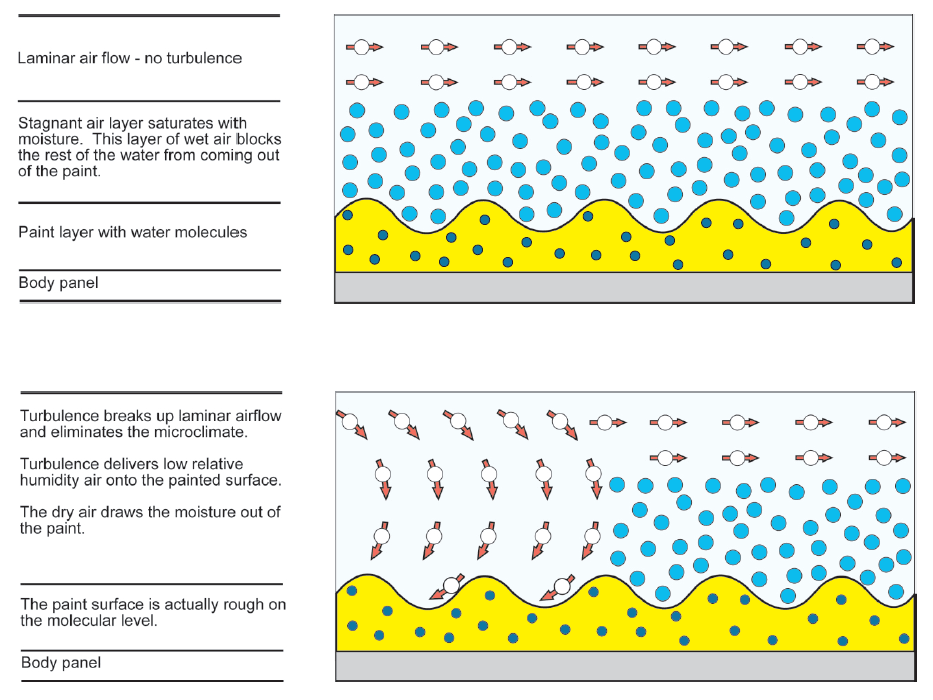
Waterborne paint dries slowly in a conventional booth because a thin layer of slow-moving air clings to the surface of the part, saturates with moisture, and traps the remaining water in the coating. Eliminating that layer is what accelerates drying. California Pulse does it through focused directional turbulence, using three elements together: nozzle inserts that give the air column a twisting motion, damper actuation that pulses the airflow into high and low pressure cycles, and a high-pressure blower that raises nozzle speed.
Waterborne paints boast lower environmental impact through lower VOC emission. Waterborne paint uses water as the primary solvent rather than volatile organic solvents (VOCs). This is the biggest reason environmental rules and regulations are pushing for the use of waterborne paints over traditional automotive paints.
Unfortunately, waterborne paints can have long drying times and traditional spray booths are not designed with this is in mind. They need fast and turbulent airflow to draw the water out of the coating at the proper rate.
We set out to create a focused directional turbulent drying system that can be retrofitted into basically any traditional booth.
How Focused Directional Turbulence Decreases Waterborne Paint Drying Times
Empty spray booths have the same climate throughout. However, when you place an object into the booth there will be a thin layer of slow-moving air that envelops the object. This layer saturates with moisture and traps the rest of the water in the coating. To effectively dry water borne paint this layer of air has to be eliminated. The best way to do this is through Focused Directional Turbulence, a concept that was first designed and proven by us at California Pulse, Inc.
Our turbulent drying systems achieve Focused Directional Turbulence through the use of three technologies:
- Airflow Rotation
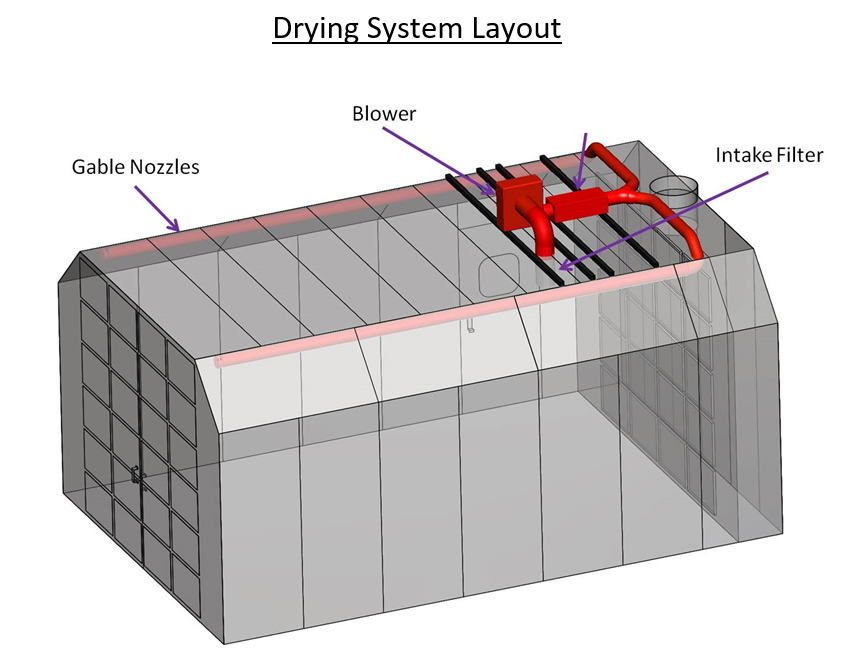
We use a nozzle-based design to focus airflow onto the surface of the vehicle effectively. The nozzles themselves have inserts that create a twisting motion of the air column as the air column leaves the nozzle.
- Pulsation System
We introduce pulsation into the airflow by the actuation of dampers. The resulting high and low pressure pulses create turbulence on the surface of the vehicle.
- High Pressure Blower
To deliver turbulent air at the highest speed possible we developed a high pressure blower. Our blower produces THE highest nozzle speed to deliver the fastest airflow of all systems in the industry.
Why Choose California Pulse for Turbulent Drying Systems
- Industry Expertise: We are the industry-leading experts in the design and application of turbulent drying systems.
- Airflow Conservation: Our systems are designed to accelerate the drying of waterborne paints through increasing air speed and creating turbulence WITHOUT hampering airflow.
- Energy Efficiency: A large amount of supplementary air is NOT needed to create turbulence or additional high speed air stream.
- Fully Integrative: Our drying systems use existing spray booth components and basic designs.
- Complete Coverage: Besides airflow, turbulence is also significantly increased over poorly drying areas like the hood and the deck lid.
Increase the drying times of your waterborne paint applications. California Pulse provides the technology, equipment, and expertise you need to be efficient.
Get a quote on our drying systems today! Contact | California Pulse
Answers