Why One-Size-Fits-All Doesn’t Work in Finishing Equipment
January 21, 2026
In industrial finishing, it’s tempting to believe that a standard, off-the-shelf solution will work for most applications. After all, many finishing systems look similar on the surface. But paint and powder coating equipment is not generic infrastructure—it is process-specific ma

Quick Answer
Off-the-shelf finishing equipment underperforms because airflow, thermal requirements, facility constraints and production volume are all process-specific. A booth designed for small flat parts struggles with large weldments, deep cavities, high-build coatings or high-throughput production, and generic airflow rates and fan selections produce turbulence, dead zones, overspray buildup and inconsistent face velocity. The cost does not disappear, it shifts from design into daily operation as extra labor, slower line speeds, rework, energy use and maintenance adjustments.
In industrial finishing, it’s tempting to believe that a standard, off-the-shelf solution will work for most applications. After all, many finishing systems look similar on the surface. But paint and powder coating equipment is not generic infrastructure—it is process-specific machinery. When a finishing system isn’t designed around the actual parts, production volume, coatings, and facility conditions, performance suffers.
“One-size-fits-all” equipment often shifts complexity and cost from design to daily operation, forcing shops to work around limitations instead of operating efficiently.
Every Finishing Process Is Different
No two finishing operations are truly alike. Differences that seem minor on paper can have major performance implications, including:
- Part size, geometry, and orientation
- Production throughput and takt time
- Coating type (liquid, powder, waterborne, solvent-based)
- Cure or flash requirements
- Facility ceiling height, layout, and available utilities
- Environmental conditions such as temperature and humidity
Standardized equipment rarely accounts for these variables in a meaningful way.
Airflow Is Not Universal
Airflow requirements change significantly depending on the application. A booth designed for small, flat parts may struggle when used for:
- Large weldments or deep cavities
- High-solids or high-build coatings
- Manual vs. automated spraying
- High-throughput production environments
One-size-fits-all booths often apply generic airflow rates and fan selections, resulting in turbulence, dead zones, overspray buildup, or inconsistent face velocity. Airflow must be engineered to the specific process—not averaged across multiple use cases.
Thermal Requirements Vary Widely
Heating and temperature control are another area where generic designs fall short. Different coatings require different:
- Flash times
- Cure temperatures
- Heat-up rates
- Air changes per minute
A system optimized for powder coating may be inefficient—or even unusable—for liquid paint applications. Likewise, an oven sized for intermittent use may fail under continuous production demands. When thermal systems are not tailored to the process, energy consumption rises and coating performance suffers.
Facility Constraints Matter
Off-the-shelf equipment often assumes ideal building conditions. In reality, many facilities have:
- Limited ceiling height
- Existing duct routes or obstructions
- Utility capacity limitations
- Local code or fire authority requirements
Forcing standard equipment into a non-standard space frequently leads to compromised airflow, awkward ductwork, or expensive field modifications. Customization at the design stage is almost always more efficient than retrofitting after installation.
Production Volume Changes the Equation
A booth or oven that performs adequately at low volume may become a bottleneck as demand increases. One-size-fits-all systems rarely scale well because they are not designed with future throughput in mind.
Common issues include:
- Insufficient air recovery time between cycles
- Inadequate heating capacity
- Filter systems that clog too quickly
- Maintenance access that disrupts production
Designing for actual—and future—production requirements protects against premature obsolescence.
The Cost of “Making It Work”
When equipment doesn’t fit the process, shops often compensate with:
- Additional labor
- Slower line speeds
- Increased rework
- Higher energy usage
- Frequent maintenance adjustments
Over time, these workarounds quietly increase the total cost of ownership far beyond the initial equipment price.
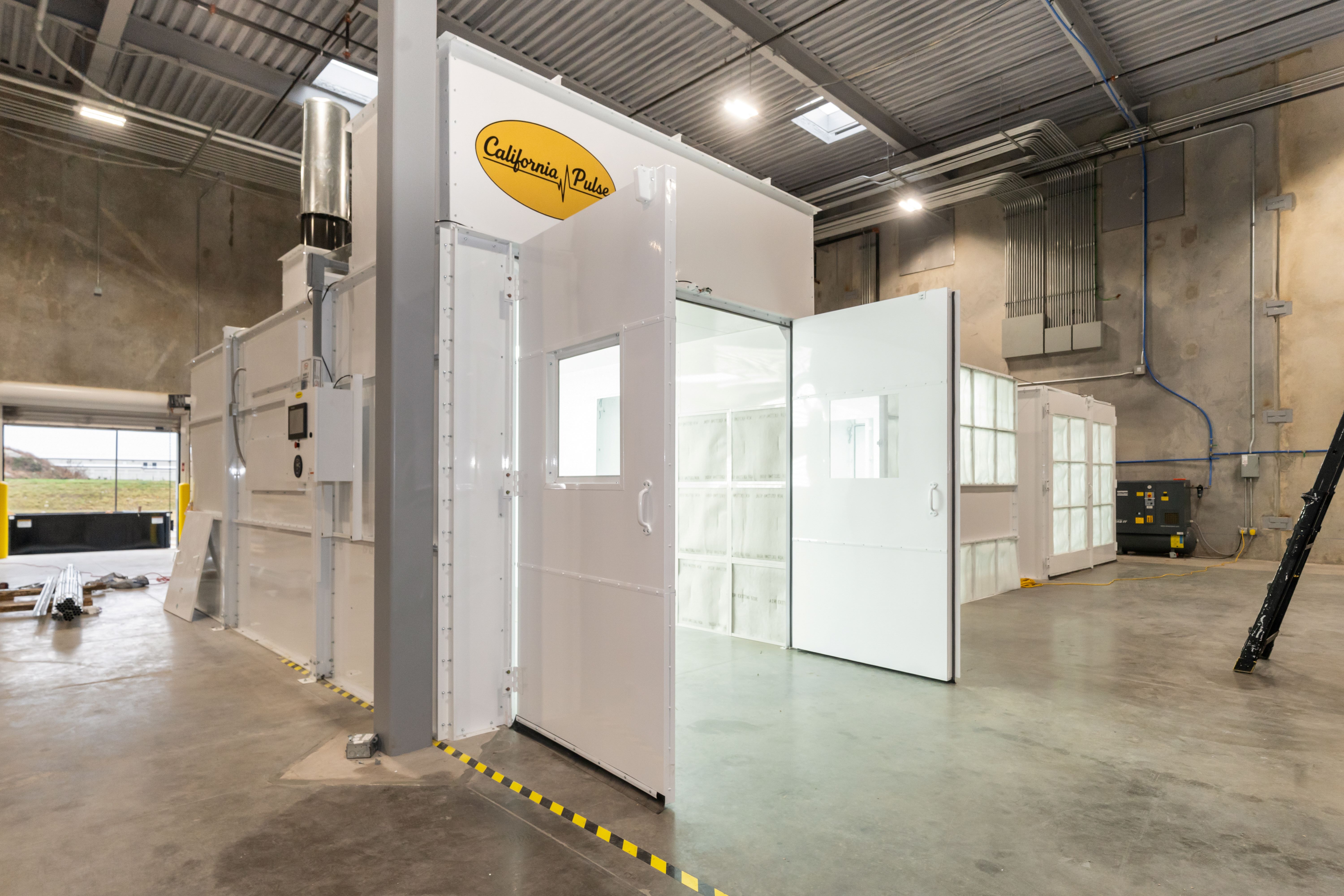
What a Properly Engineered System Looks Like
A finishing system designed around the application will:
- Match airflow volume and velocity to part geometry
- Maintain stable thermal conditions for the coating
- Fit the facility without compromise
- Meet applicable safety and fire codes
- Support consistent production and quality goals
Customization does not mean complexity—it means alignment between equipment and process.
Why California Pulse Rejects One-Size-Fits-All
At California Pulse, we design finishing equipment as integrated systems, not catalog items. Our approach starts with understanding:
- The parts being coated
- The coatings being used
- The required throughput
- The facility constraints
- The long-term production goals
From there, airflow, heating, structure, and controls are engineered to work together—not forced into a generic template.
In finishing operations, standardization may simplify purchasing, but it rarely simplifies operation. Equipment that isn’t designed for the process ultimately costs more in inefficiency, energy, and downtime.
One-size-fits-all doesn’t work in finishing—because your process isn’t one-size-fits-all.
Contact California Pulse to discuss a finishing solution engineered for your process, your facility, and your production goals.
Answers